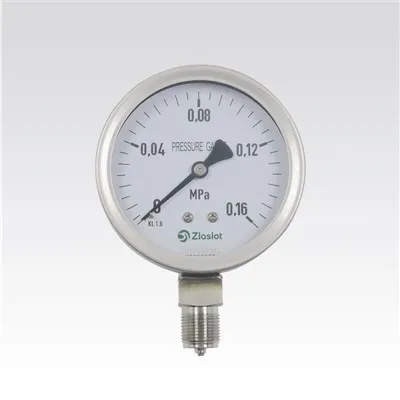
What is the difference between Bourdon tube and diaphragm pressure gauges?
Leave a message

Hey there! As a pressure gauges supplier, I've been in the thick of all things related to these nifty devices for quite a while. One question that often pops up is, "What's the difference between Bourdon tube and diaphragm pressure gauges?" Well, let's dive right in and break it down.
First off, let's talk about Bourdon tube pressure gauges. These bad boys have been around for ages. They're like the old - school reliable workhorses of the pressure - measuring world. The basic principle behind a Bourdon tube gauge is pretty straightforward. Inside the gauge, there's a curved tube, usually made of metal like brass or stainless steel. When pressure is applied to the inside of this tube, it tries to straighten out. This movement is then transferred through a series of gears and levers to a pointer on the gauge face, which shows the pressure reading.
Bourdon tube gauges are known for their durability and accuracy over a wide range of pressures. They can handle high pressures really well, making them a top choice in industrial applications where you've got to measure things like steam pressure in a power plant or hydraulic pressure in heavy machinery. They're also relatively simple in design, which means they're generally easy to maintain. If something goes wrong, it's usually not too hard to figure out what the problem is and fix it.
On the flip side, diaphragm pressure gauges work a bit differently. Instead of a curved tube, they use a flexible diaphragm. This diaphragm is typically made of materials like rubber, metal, or a combination of both. When pressure is applied to one side of the diaphragm, it flexes. This flexing is then converted into a pressure reading on the gauge face, often through a mechanical linkage or an electrical sensor.
Diaphragm gauges are great for measuring low pressures. They're super sensitive, so they can pick up even the slightest changes in pressure. This makes them ideal for applications like measuring gas pressure in a laboratory or the pressure in a ventilation system. They're also less likely to be affected by vibrations compared to Bourdon tube gauges. Since the diaphragm is a flat, flexible surface, it can absorb vibrations better, which means more accurate readings in environments where there's a lot of shaking going on.


Now, let's talk about some of the other differences between these two types of gauges. In terms of size, Bourdon tube gauges tend to be a bit bulkier. The curved tube takes up more space inside the gauge housing, so they're usually larger overall. Diaphragm gauges, on the other hand, can be made much smaller because the diaphragm is a flat component. This makes them a better choice when you're working in tight spaces and need a gauge that can fit in a small area.
Accuracy is another important factor. While both types of gauges can be accurate, the accuracy range can vary. Bourdon tube gauges are generally more accurate at higher pressures, but their accuracy might drop off a bit at lower pressures. Diaphragm gauges, as I mentioned earlier, are extremely accurate at low pressures, but they might not be as precise when it comes to measuring really high pressures.
Cost is also something to consider. Bourdon tube gauges are often more cost - effective, especially for high - pressure applications. Their simple design and widespread use mean that they're mass - produced, which drives down the cost. Diaphragm gauges, especially those with high - end materials and advanced sensors, can be more expensive. But if you need the high sensitivity and low - pressure accuracy, the extra cost might be worth it.
Let's take a look at some specific applications where these gauges shine. If you're in the oil and gas industry, Bourdon tube gauges are your go - to for measuring the pressure of pipelines. The high pressures involved require a gauge that can handle the stress, and the durability of the Bourdon tube makes it a reliable option. For the food and beverage industry, diaphragm gauges are often used. They're great for measuring the pressure in tanks where food products are stored or processed. The ability to measure low pressures accurately and the fact that they can be made with food - grade materials make them suitable for this type of application.
Now, if you're in the market for a pressure gauge, we've got a great selection. Check out our Vacuum Digital Pressure Gauge. It's a high - tech option that can give you accurate readings in a vacuum environment. We also have High Temperature Mechanical Melt Presssure Gauges for those applications where you've got to measure pressure in high - temperature conditions. And if you're looking for something more modern, our Digital Melt Presssure Gauges offer digital readouts and advanced features.
So, whether you need a Bourdon tube gauge for high - pressure industrial work or a diaphragm gauge for low - pressure, sensitive applications, we've got you covered. If you're interested in learning more or want to start a purchase negotiation, just reach out. We're here to help you find the perfect pressure gauge for your needs.
References
- "Pressure Gauge Handbook" - A comprehensive guide on different types of pressure gauges and their applications.
- "Industrial Instrumentation and Control" - A textbook that covers the principles behind pressure measurement devices.