

What is Temperature Transmitter
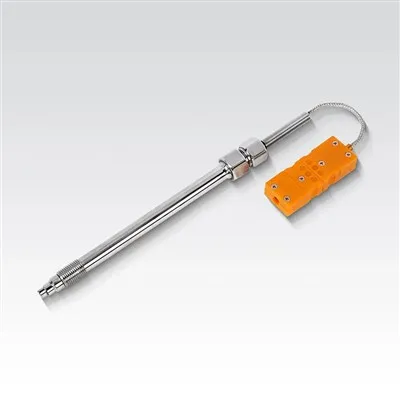
A temperature transmitter is an electrical instrument that interfaces with the temperature sensor to isolate, amplify, filter noise, and convert the signal from the sensor to send it to the control device. Its primary function is to measure and alert temperature changes. A temperature transmitter is an essential device for accurate temperature measurement and monitoring in industrial processes. It's connected to a temperature sensor and converts analogue thermal measurements into digital output signals with minimal interference, which represents the process variable temperature being measured and controlled.
Advantages of Temperature Transmitter
Improved signal integrity, especially over long distances. Using shielded twisted pair wiring provides even higher EMI resistance.
Standardized output. Unlike the output from direct wiring, the 4 to 20 mA signal is compatible with most data acquisition, recording and display systems, allowing standardization of hardware.
Improved accuracy. Clipping the milliamp output to part of the sensor's range can improve resolution and yield greater accuracy. Additionally, some transmitters can detect thermocouple drift and provide an alert before problems arise.
Less expensive wiring. Thermocouple extension wires are usually made from the same material as the device itself, so are more expensive and more fragile than standard twisted pair wiring. Twisted pair is more easily “pulled” and as it costs less per foot results in substantial savings over the long run.
Simplified maintenance. Twisted pair wiring stands up better in hostile environments so cable breaks and short circuits are less common and easily detected if they do occur. “Smart” transmitters can send diagnostic information so problems are understood before a technician starts tracing wiring and looking for faults.
Retrofit and upgrade flexibility. Once temperature transmitters are installed, should the process change and a different thermocouple be needed, only the sensor itself has to be changed. Conversely, a transmitter can be installed using existing direct wire connections.


Why Choose US
Our Factory:Shanghai Ziasiot Technology Co., Ltd. is an experienced manufacture of pressure and temperature sensors, transmitters.
Products:The main products developed and produced by our company consist of multiple series, including wireless sensors, flow sensors, linears, pressure sensors, liquid level sensors, high temperature melt pressure sensors , melt pressure gauge, high temperature melt pressure transmitter, temperature sensor, fusion index instrument, pressure calibration system, smart digital instrument, blasting switch, smart home system, smart module, smart body scale, laboratory instrument, Internet of Things, and Automated complete control system.
Our Certification:In order to emphasize Our commitment to quality and reputation, the R & D and production process of all zias brands ensure to meet and possess RoHS, ISO, CE, CMC, CPA, ex and other certifications.
Production and Quality:ZiasIOT devotes itself to enhancing manufacturing industry and its productivity. The capability of controlling temperature and pressure in industrial field is vital to promote productivity and produce high-quality products.
Types of Temperature Transmitter
Weather-Proof and Explosion-Proof Transmitters
In applications where a transmitter must withstand the wear and tear associated with continuous exposure to the elements, a weather- and explosion-proof transmitter is appropriate. This particular type of transmitter has an external enclosure, usually made of stainless steel or a designated explosion-proof material, which is sealed tightly to protect the sensitive internal components. Inside, the transmitter is divided into two small chambers: one contains the sensor and the other contains the electronics associated with calculating temperature and transmitting a new signal. Weather-proof and explosion-proof transmitters tend to have a high level of accuracy, and can usually be adjusted and monitored locally, if needed.
Panel Mount or DIN Rail Mount Transmitters
A DIN rail is used to mount switches, relays, and transmitters. The rail itself is a piece of metal that is shaped to enable a device (such as a transmitter) to be attached using a spring clip, which slides into a bend in the metal rail and secures itself. The metal rail, complete with attached transmitter, can then be attached to a panel or a wall. The acronym DIN stands for Deutsches Institut fur Normung, which is the German Institute for Standardization. DIN rail transmitters, also called panel mount transmitters, are usually found in diverse applications because they are relatively low-cost and can operate with an array of different sensors. Because of the DIN rail configuration, they are also easy to install. They are somewhat less accurate than weather- and explosion-proof transmitters because of the longer wiring configuration necessary for securing the transmitter. For temperature transmitters, rail mounting is the oldest mounting method.
Head Mount Transmitters
Head mount transmitters incorporate the transmitter into the connection head, or exterior housing, of a sensor. Because of this design, they are easy to install and require minimal wiring, as the sensor head simply becomes a sensor head transmitter.

The temperature sensors are used for verifying design assumptions that will promote safer and more economical design and construction.
They are used to measure the temperature rise during the process of curing concrete.
They can measure rock temperatures near liquid gas storage tanks and ground freezing operations.
Temperature sensors can also measure water temperatures in reservoirs and boreholes.
It can be used to interpret temperature-related stress and volume changes in dams.
They can also be used to study the temperature effect on other installed instruments.
A temperature transmitter draws current from a remote dc power supply in proportion to its sensor input. The actual signal is transmitted as a change in the power supply current.
Specifically, a thermocouple input transmitter will draw 4 mA of current from a dc power supply when measuring the lowest temperature of the process. Then, as the temperature rises, the thermocouple transmitter will draw proportionally more current, until it reaches 20 mA. This 20 mA signal corresponds to the thermocouple's highest sensed temperature. The transmitter's internal signal-conditioning circuitry (powered by a portion of the 4-20 mA current) determines the temperature range that the output current signal will represent.
Physically, only two copper wires are necessary to connect the temperature transmitter output signal in a series circuit with the remote power supply and the process equipment. This is made possible since the signal and the power supply line are combined (one circuit serves a dual function).
Universal And Accessible Transmitter Calibration
During temperature transmitter calibration process, the sensor is replaced by a device that produces a range of resistances. A special device is used for calibration, that can simulate RTDs and Thermocouples. Calibration devices are programmed using a special software, connected to a computer via a USB.
Process calibration ensures extreme accuracy
In applications making heavy demands on accuracy, the combined inaccuracy of sensor and transmitter may be too great. The solution is to calibrate the transmitter to match the specific sensor.
What's the Difference Between a Temperature Sensor and a Temperature Transmitter
While a temperature sensor measures or senses the physical temperature and converts it into measurable units of electrical current, including voltage or resistance, a temperature transmitter is a device connected to the sensor that converts the measured temperature into a signal to be seen, logged, and maintained.
Both devices have critical roles in ensuring accurate temperatures are measured and communicated for control.
Temperature Sensor
A temperature sensor is a device that measures temperature through an electrical signal generated by two metals that produce electrical voltage or resistance in response to temperature changes. These signals can be converted into a temperature reading.
Temperature Transmitter
A temperature transmitter is an electrical instrument that interfaces with the temperature sensor to isolate, amplify, filter noise, and convert the signal from the sensor to send it to the control device. Its primary function is to measure and alert temperature changes.
Temperature Transmitters From Process Parameters
A temperature transmitter is an essential device for accurate temperature measurement and monitoring in industrial processes. It's connected to a temperature sensor and converts analogue thermal measurements into digital output signals with minimal interference, which represents the process variable temperature being measured and controlled.
The advantages of using temperature transmitters include eliminating the need for special cabling requirements, enabling advanced diagnostics, and offering much greater noise resistance over long distances.
How Do Temperature Transmitters Work
Transmitters aim at amplifying and filtering the signal from the temperature sensor. How this is done varies slightly based on the sensor in use.
Sometimes, this analog signal is converted to a digital signal (ADC) to allow for additional functions (such as calibration and scaling), then returned to an analog signal. The conditioning circuitry can be designed for resistance values from 15 to 380ohms or something similar to accommodate the full range of RTD values.
The electronics inside the transmitter will draw 4mA from the power supply when the temperature is at the low-end setpoint and will draw 20mA when the sensor is at the high-end temperature setpoint. For example, if your temperature range of your sensor is 0-100 ℃, then a 4mA signal would correspond to 0℃ . In the same way, 20mA would represent 100℃. Using 4mA as the low reference makes it much easier to notice when your system is malfunctioning.
Signal Acquisition: The transmitter collects the voltage or resistance signal from the temperature sensor.
Signal Conditioning: It then processes and conditions the signal (e.g. cold junction compensation for thermocouples) to ensure accuracy and stability.
Output Signal Generation: The transmitter generates a standardised output signal, such as 4-20 mA, or 0-5Vdc which is proportionate to the temperature measurement. For example, the transmitter can be programmed to give a linearised 4-20mA output over a range of 0ºC to 100ºC where 4mA represents 0ºC and 20mA represents 100ºC.
Signal Transmission: This standardised output signal can then be transmitted over long distances (useful for thermocouple signals to eliminate volt drop errors) as part of a 2 wire loop to instrumentation, data loggers, temperature controllers or PLCs.
The most common types of inputs for temperature transmitters are thermocouples and RTDs.Thermocouple Input
In the industry today, transmitters for thermocouples are normally designed for the base metal thermocouples. Those are type: K,T, J, and E. That doesn’t mean that you won’t be able to find transmitters for other types of thermocouples but they may be more expensive.
Thermocouples have two wires, so the transmitters will have two input terminals where the wires can be connected. It is important to wire the thermocouple correctly. The transmitter should be purchased with cold junction compensation. Cold junction compensation is used as a reference for the junction that is immersed in the environment.
Thermocouple transmitters will have a Zero and Span dialog that will be used for calibration purposes. You must fine turn the device using these potentiometers, if you notice your device is reading incorrect values.


Applications for Temperature Transmitters
Temperature transmitters are used for various applications in a wide range of industries, including:
Industrial Processes: For precise temperature control and monitoring in manufacturing and chemical processes.
HVAC Systems: To monitor and regulate heating, ventilation, and air conditioning systems.
Scientific Research: In laboratories and scientific experiments.
Energy Management: In energy-efficient and cost-effective temperature control solutions.
Petrochemical / Oil and Gas: ATEX approved transmitters are available for a wide range of uses within the Oil and Gas Industry.
Type of Sensors: The smart temperature transmitters often feature either RTD or thermocouple sensors. The actual activity of temperature measurement is performed by the sensor itself, therefore, the type of temperature sensor is a prime consideration while choosing a transmitter. The factors like temperature fluctuations, moisture, corrosion, contact lead degradation, etc can impact the sensor performance, and therefore, one must go for high-quality sensors.
Mounting Location: The mounting location is a crucial consideration while buying a temperature transmitter. If the distance between the transmitter and control panel is less and if there is no noise interruption, the installation can cost less. One should also consider if the transmitter has to be installed overhead, outdoors, or at tactical in-field locations. If the transmitter is to be installed in hazardous location then you must check if the transmitter can support remote installation and monitoring.
Configuration Protocol: Although smart transmitters may have similar designs, they use different configuration protocols. Highway addressable remote transducer (HART) protocol and PC configuration protocols like Profibus, Foundation Fieldbus, etc are commonly preferred in the industrial transmitters. The purpose of configuration protocols is to offer remote accessibility, authentication feature, and operator control. Therefore, one must use the configuration protocol that is compatible with the existing system.
Measurement Accuracy: Accuracy is an essential selection criterion for temperature transmitters as an error or delay in temperature measurement can lead to expensive and hazardous damage. Therefore, one must not go for low accuracy transmitters. Considering the industrial demand, the accuracy range one must look for is ±0.0025˚ F to 1˚ F. The factors like cold junction compensation, line voltage effect, EMI/RFI interruption, etc impact the accuracy, therefore, one must choose a transmitter immune to such problems.
EMI/RFI Immunity and Signal Isolation: Electromagnetic interference and radio frequency interference can cause signal degradation, non-repeatability, lack of accuracy and efficiency, etc. Therefore, one must go for a transmitter with strong immunity against EMI/RFI.
Diagnostic and Troubleshooting Capabilities: The smart transmitters feature several electronic part integrations, therefore, it is difficult for the operator to figure out the problem while diagnosis or troubleshooting. However, there are several smart transformers in the market that feature automatic error detection, diagnostic, and troubleshooting. Due to the automatic diagnostic abilities, the sensors are continuously monitored and circuits are tested periodically by the transmitter itself. This helps in instant error detection and resolution.
Special Functionality: In order to get the best fit for your requirements, you can look for temperature transmitters with special functionalities. This way, one can get customized products for their applications. The special functionalities can be application-specific process parameters, sensor trimming, indicative alarms, no-standard inputs, etc.
FAQ
Q: What is meant by temperature transmitter?
Q: Where are temperature transmitters used?
Q: How do you use a temperature transmitter?
Q: What is the difference between a thermometer and a temperature transmitter?
Q: Why use a temperature transmitter?
Q: What is the output of a temperature transmitter?
Q: How does a temperature sensor work?
Q: How do you check a temperature transmitter?
Q: Is a temperature transmitter input or output?
Q: What is the difference between a pressure transmitter and a temperature transmitter?
Q: How accurate is a temperature transmitter?
Q: How many types of temperature transmitters are there?
Q: Is thermocouple a temperature transmitter?
Q: What is the difference between thermocouple and temperature transmitter?
Q: What is infrared temperature transmitter?
Q: What is the basic principle of a temperature transmitter?
Q: How does a 4-20 mA temperature transmitter work?
Q: What is pressure and temperature transmitter?
Q: Do temperature transmitters require calibration?
Q: How do I protect my temperature sensor?
As one of the most professional temperature transmitter manufacturers and suppliers in China, we're featured by quality products and low price. Welcome to wholesale the best selling temperature transmitter for sale here from our factory. Contact us for customized service.
Digital Display Melt Pressure Transmitter