

Advantages of Ziasiot Pressure Gauges
Readability:Digital pressure gauges are easy to read, typically featuring a backlit LCD display. In other words, the gauge is easily visible regardless of lighting conditions. Additionally, there are digital gauges that offer 10 different types of pressure units for easy measurement. This includes the PDR100, 250 , 500 and 1000 that are a part of the PDK range.
Accuracy:Another advantage that digital gauges hold is that readings are often more accurate. GTS Gauges stock gauges ranging from 0 to 5000 bar with 0.5%-0.025% full-scale accuracy, for extra convenience. Parallax issues are also avoided by digital gauges, since they display the result regardless of the angle from which it is viewed.
Mechanical Resilience:Analog pressure gauges can become difficult to read when subjected to high vibrations. There may be movement of the needle on the gauge. However, in digital gauges, vibration does not have a noticeable impact because of the way that they are displayed.
Cost effectiveness:Analog gauges are usually less expensive initially, but they require more frequent replacement. An investment into a digital pressure gauge means that if handled properly, it will last several years.


Why Choose US
Our Factory:Shanghai Ziasiot Technology Co., Ltd. is an experienced manufacture of pressure and temperature sensors, transmitters.
Products:The main products developed and produced by our company consist of multiple series, including wireless sensors, flow sensors, linears, pressure sensors, liquid level sensors, high temperature melt pressure sensors , melt pressure gauge, high temperature melt pressure transmitter, temperature sensor, fusion index instrument, pressure calibration system, smart digital instrument, blasting switch, smart home system, smart module, smart body scale, laboratory instrument, Internet of Things, and Automated complete control system.
Our Certification:In order to emphasize Our commitment to quality and reputation, the R & D and production process of all zias brands ensure to meet and possess RoHS, ISO, CE, CMC, CPA, ex and other certifications.
Production and Quality:ZiasIOT devotes itself to enhancing manufacturing industry and its productivity. The capability of controlling temperature and pressure in industrial field is vital to promote productivity and produce high-quality products.
Types of Pressure Gauges
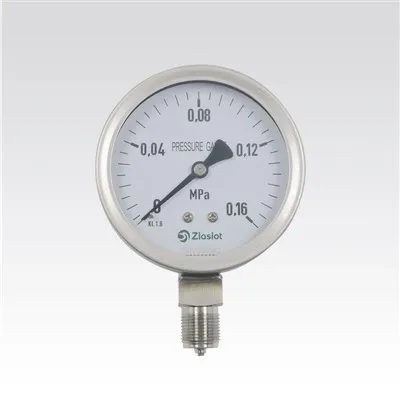
A bourdon tube is the most commonly used pressure gauge. It is a mechanical instrument that measures the pressure without an electric supply. It is made of steel to resist wear and corrosion. A bourdon tube pressure gauge can measure pressure from 0.6 to 7000 bar (8 to 10000 psi). It is compatible with liquid or gaseous media for vacuum, as well as low and high-pressure applications. It is a compact instrument that is ideal for heavy vibration application and dynamic pressure load. The bourdon tube pressure gauge is as shown below.
It is the device used to measure the pressure of fluid in a system. It is purposefully designed to measure low-pressure intensities. A diaphragm pressure gauge is also known as a membrane pressure gauge. This device uses the deflection of a flexible thin membrane known as the diaphragm. The pressure is indicated by using a needle, which is moved with the help of pinion arrangement with the diaphragm.
In this type of pressure gauge, two corrugated diaphragms are welded together at their periphery to form a capsule. This capsule is the main element in sensing the pressure. A hole is present in one of the diaphragms in the center which lets the medium enter. The diaphragms expand or contract upon the application of pressure. The capsule pressure gauge is used for calculating the pressure of gases and is utilised for calculating the pressure of substances with up to 600 mbar.
These are the instruments ideally used to measure the pressure independent of the natural fluctuations in atmospheric pressure. A reference measure of vacuum is fixed to the side of the measuring element and is not subject to pressure. Hence, it has zero pressure with no variation. They are mainly used in scientific laboratories. Altitude does not affect the absolute pressure gauges, hence they are used in aeronautics, Heating, ventilation, and air conditioning systems, and distillation processes.
Pressure Difference Formula
The pressure difference between the system and the atmosphere is given by the formula:
P=Pa+ ρgh
Where,
P= pressure at any point
Pa = atmospheric pressure
From this, we can make out that the pressure at any point is always greater than the atmospheric pressure by ρgh amount.
When P-Pa=ρgh
Where,
P =pressure of the system
Pa=atmospheric pressure
(P-Pa) = pressure difference between the system and atmosphere.
hρg = Gauge pressure
The difference between two pressures measured using the gauge is known as gauge pressure. Now, let us know more about the types of pressure gauges.

Choosing the Right Pressure Gauge
Range
It is ideal to select a pressure gauge that is approximately twice the normal operating pressure of the media. Furthermore, the maximum operating pressure should not exceed 75% of the full-scale range.
Size
The size of the pressure gauge will usually correlate with the gauge's accuracy.Larger pressure gauges will generally have greater resolution or readability.
Material
The material of the pressure gauge is important when considering the environment in which it is going to be used. Assess if the gauge is going to be subject to higher levels of moisture or more severe weather conditions. Stainless steel pressure gauges should be opted for over brass around more corrosive substances.
Accuracy
Accuracy is defined as a percentage of the full-scale range. For example, 63mm gauges will generally have 1.6% full-scale accuracy (FSA), likewise for 100mm and 160mm gauges where they will generally have 1% FSA. The degree of accuracy required should be determined to ensure that a suitable gauge is used. Choosing between an analogue ordigital pressure gauges is also another factor to be considered as they have different degrees of accuracy. A general rule of thumb is that the more critical the application, the higher the accuracy required.
Connections
Along with theconnection size, the location should also be considered when selecting a pressure gauge. GTS stock a range of rear-entry and bottom-entry gauges to meet your application needs.
How Pressure Gauges Are Made
Case
The cases for pressure gauges are made of plastic, steel, brass, or, most commonly, stainless steel. The complexity and type of case is a good indication of how expensive the gauge is. Phenolic, a resin made from phenols and aldehydes, cases are used in aggressive and harmful environments such as those for chemical and petrochemical production.
Cases can be filled with glycerin or silicone to prevent condensation and provide protection from corrosive environments that could damage the internal mechanism. Rubber gauge covers are available to protect the gauge‘s case from impact damage.
Socket
The socket is the first part of the pressure gauge the pressurized fluid contacts. Inexpensive gauges have a hole drilled at the outlet connection, while more expensive gauges have a threaded hole for a restrictor orifice. The insertion of a restrictor orifice prevents particles from entering the gauge and jamming the gauge.
Welding Style
One end of the Bourdon tube is welded where the linkage is attached. Less expensive pressure gauges use a stamping or a mechanical device to attach the linkage.
Pointer
The types of pointers vary according to the types of fine adjustments that the pointer permits and the pointer‘s complexity. More complex and refined pointers allow for adjustments for changes in altitude or wear from pulsations and vibrations.
Display
The readings on a pressure gauge can appear in a dial fashion analog display or as a digital readout. As other factors, the types of displays vary depending on the type and design of the pressure gauge. A pressure gauge‘s dial scale is calibrated to the design and type of pressure gauge. In the case of the Bourdon tube, the dial is calibrated to the Bourdon tube.
Window
The front or face of a pressure gauge is the window that protects it from the environment and protects the internal mechanism. It can be made of glass, tempered glass, or plastic. Windows made of soft plastic flex for thermal compensation and allow the glycerin or silicone fill to expand without bleeding. The window serves as a clear membrane that permits the user to see the dial of the gauge and read the data.
Pressure is a physical and measurable force, per area, that is exerted against an object by a substance, material, other object, or gas that is in contact with it. In the case of liquids or gases, their weight exerts increased pressure as the amount increases.
Pascals (Pa) is the unit of pressure or stress applied over an area of one meter squared and is equal to one Newton (1N). Pascals serve as the base unit of pressure for the International System of Units (SI), the modern form of the metric system.
Bar or Millibar is a metric unit of pressure that is equal to 100,000 Pa.
Atmosphere (atm) is a unit of measure that is equal to the average air pressure at sea level at a temperature of 15°C or 59°F. One atmosphere is 1013 millibars or 760 mm or 30 inches of mercury. It is measured by a barometer.
Torr is a unit of measure that is named after Evangelista Torricelli, the discoverer of the barometer. A Torr is 1/760 of a standard atmosphere or 101,325 Pa.
Pounds Per Square Inch (psi) is a unit of measure that is expressed in pounds of force per square inch of area, which is equal to 6894 Pa or 0.07 atm or 51.175 torr. PSI is based on the avoirdupois system of measurement, which uses pounds and ounces as units of measure.
Millimeters of Mercury (mm Hg) is a unit of measure that once stood for the pressure created by one millimeter of mercury. It is not an SI unit but is used in certain industries and scientific studies. Its modern definition is 133.322387415 Pa, which is equal to one Torr.
Inches of Water (in H2O) is a unit of measure that is determined by the pressure exerted at the base of a column of fluid that is one inch high and has a fluid density of 1.004514556 grams per cubic centimeter at a location where the gravity acceleration is at 9.80665 m/sec².
Automobiles
When discussing pressure gauges for a car, the first thing that comes to mind is the air pressure gauge for the tires. Though an air pressure gauge is important, there are several other pressure gauges that monitor various car systems, such as the air conditioning, oil, and engine coolant. Modern cars have gauges and meters on almost every critical component.
Aeronautics
There are a wide variety of instruments that inform a pilot of an aircraft's condition and pressure variances. Pressure sensing devices can be found in the flight group and engine group. They are the most critical and essential aspects of an airplane's operation, as they are a means of preserving its safe functioning. Each type of pressure gauge is designed to fit a specific application.
Oil Production
In the oil industry, flow lines, separators, and stock tanks are all under some form of pressure. Every aspect of an oil operation, from the wellhead to the tank, is monitored and overseen by a pressure gauge. All gauges for the oil industry have safety measures built into them for the protection of workers since they can blow out when the pressure gets too high.


Food Industry
Pressure gauges for the food industry are required to be exceptionally hygienic and are made of stainless steel grade 316, which is allowed to be exposed to the media.
Food grade pressure gauges are able to withstand the regular rigorous cleaning that is a necessary part of the food preparation process.
Chemical Industry
Pressure gauges for the chemical industry are specially designed to meet the needs of a variety of mediums and highly aggressive environments. Chemical industry pressure gauges require frequent repair and replacement. For protection of the instrument, chemical industry pressure gauges are coated in Tantalum, Halar, or Polytetrafluoroethylene (PTFE), which are exceptionally corrosion resistant.
Hydraulic
A hydraulic pressure gauge is a critical part of the operation of a hydraulic device. Inadequate pressure gauges can adversely affect the system‘s performance and can be damaging to the flow of a manufacturing process. Any detectable pressure changes can indicate leaks in the system or damage to a hydraulic component. Hydraulic pressure gauges must be exceptionally accurate and capable of functioning in harsh and hazardous conditions.
Maintenance of Pressure Gauge
The pressure gauge should be kept clean, the glass on the dial should be bright and clear, so that the pressure value indicated by the pointer in the dial can be easily visible. And the pressure gauge with broken glass on the dial or blurred dial scale should be abolished.
The connecting pipe of the pressure gauge should be blown regularly to avoid blockage, especially the connecting pipe used for gas with more oily dirt or other viscous substance.
You should often check whether the rotation and fluctuation of the pressure gauge pointer are normal, and whether the cock on the connecting pipe is in the fully open position.
The pressure gauge must be calibrated regularly, and the frequency can be based on the specific conditions:
1) After the pressure gauge has been in operation for three months, level 1 maintenance must be applied mainly to check whether the pressure gauge can return to zero position, and whether the tee cock and the water trap joint are leaking. And we must check and flush the water trap to ensure smooth flow.
2) After a year of operation, level 2 of maintenance must be applied. At this time, the pressure gauge can be disassembled and sent to the measurement department for verification and lead sealing. When we disassemble and check the trap, the threaded fasteners should be found intact. Disassemble and check the three-way cock, grind the sealing surface to ensure that it is tight without leakage, and the connection thread should be intact. Store the trap, remove the rust and paint the three-way cock.
When the pressure gauge is inaccurate during operation, it must be replaced in time. The replacing gauge must be a lead-sealed pressure gauge that has been verified by the metrology department and is within the validity period of the verification or a new one with a factory certificate. Before changing the meter, the three-way cock must be screwed to the position of flushing the pressure gauge, and the dirt in the trap pipe must be flushed.
FAQ
Q: What is a pressure gauge used for?
Q: What is meant by gauge pressure?
Q: What is the principle of pressure gauge?
Q: Do you need a pressure gauge?
Q: What is an example of gauge pressure?
Q: Why is it called a pressure gauge?
Q: What is the difference between gauge pressure and normal pressure?
Q: What is the difference between a pressure indicator and a pressure gauge?
Q: Do pressure gauges measure static pressure?
Q: Can a pressure be negative?
Q: How can I measure pressure without a gauge?
Q: How accurate are pressure gauges?
Q: What type of pressure gauge is most accurate?
Q: What is the difference between a pressure gauge and a flow meter?
Q: How to calculate pressure?
Q: How do you classify a pressure gauge?
Q: Do pressure gauges measure absolute pressure?
Q: Is pressure gauge analog or digital?
Q: Does gauge pressure change?
Q: How do you read pressure gauge pressure?
As one of the most professional pressure gauges manufacturers and suppliers in China, we're featured by quality products and low price. Welcome to wholesale the best selling pressure gauges for sale here from our factory. Contact us for customized service.
Digital Display Melt Pressure Transmitter, Homogenizer Pressure Gauge, Series Burst Plugs Nickel Alloy Extruder Rupture Disc