
What is the difference between analog and digital pressure gauges?
Leave a message

Hey there! As a pressure gauges supplier, I've been dealing with all sorts of pressure gauges for years. One question that comes up a lot is, "What's the difference between analog and digital pressure gauges?" Well, let's dive right in and break it down.


How They Work
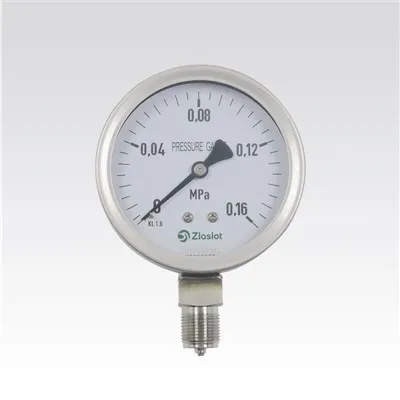
First off, let's talk about how these two types of gauges operate. Analog pressure gauges have been around for ages. They're based on a pretty simple mechanical principle. Inside an analog gauge, there's a sensing element, usually a Bourdon tube. When pressure is applied, this tube deforms. That deformation is then transferred through a series of gears and levers to a pointer on the dial. The pointer moves along a calibrated scale, showing you the pressure reading. It's like a well - oiled machine, all mechanical parts working together to give you a visual indication of the pressure.
On the other hand, digital pressure gauges are a more modern invention. They use electronic sensors to measure pressure. These sensors convert the pressure into an electrical signal. Then, an electronic circuit processes this signal and displays the pressure reading on a digital screen. It's a high - tech way of getting the job done, relying on electronics rather than mechanical parts.
Accuracy and Precision
Accuracy is a big deal when it comes to pressure gauges. Analog gauges are generally accurate, but their precision can be limited. Reading an analog gauge depends on the user's ability to interpret the position of the pointer on the scale. There's always a bit of human error involved. You might have to estimate the reading between two markings on the scale, especially if the pressure is in between the calibrated values.
Digital gauges, on the other hand, offer much higher precision. They can display pressure readings with a high number of decimal places. This means you can get a very accurate measurement, down to the smallest increment. For applications where precise pressure control is crucial, like in scientific research or high - tech manufacturing, digital gauges are often the better choice.
Readability
Readability is another factor to consider. Analog gauges have a classic look. The large, circular dials with a pointer are easy to read at a glance, especially from a distance. You can quickly get a general idea of the pressure level just by looking at the position of the pointer. This makes them great for applications where you need to monitor pressure continuously, like in industrial settings.
Digital gauges, however, have a more modern aesthetic. Their clear, numerical displays are very easy to read, especially in low - light conditions. You don't have to worry about interpreting the position of a pointer; the exact pressure value is right there on the screen. But if you're looking at the gauge from a distance, it might be harder to make out the numbers on a digital display compared to an analog pointer.
Durability
When it comes to durability, analog gauges have an edge. Since they're mostly mechanical, they're less likely to be affected by electrical interference or power outages. They can withstand harsh environments, including vibrations, shocks, and extreme temperatures. For example, in a manufacturing plant where there's a lot of machinery running and causing vibrations, an analog gauge can keep working reliably.
Digital gauges, on the other hand, are more sensitive. They rely on electronics, which can be damaged by electrical surges, moisture, or extreme temperatures. However, many modern digital gauges are designed with protective features to make them more durable. But in general, if you're working in a really tough environment, an analog gauge might be a safer bet.
Cost
Cost is always a consideration. Analog gauges are usually less expensive than digital gauges. The mechanical components used in analog gauges are relatively simple and inexpensive to manufacture. This makes them a budget - friendly option, especially for applications where high precision isn't required.
Digital gauges, with their electronic sensors and circuits, are more expensive to produce. The technology behind them is more complex, which drives up the cost. But if you need the high accuracy and additional features that digital gauges offer, the extra cost might be worth it.
Additional Features
Digital gauges often come with a range of additional features that analog gauges don't have. For example, many digital gauges can store pressure readings over time. This is useful for data logging and analysis. You can review the pressure history and look for trends or anomalies. Some digital gauges also have the ability to connect to a computer or other devices via USB or Bluetooth. This allows you to transfer the data for further processing.
Digital gauges can also offer alarm functions. You can set a maximum or minimum pressure limit, and the gauge will sound an alarm if the pressure goes outside of this range. This is a great safety feature, especially in applications where over - or under - pressure can cause damage or danger.
Analog gauges, in contrast, are pretty basic in terms of features. They just show the current pressure reading and that's it.
Applications
The choice between analog and digital gauges also depends on the application. In industries like oil and gas, analog gauges are still widely used. They're reliable, durable, and easy to install. They can withstand the harsh conditions found in oil rigs and refineries.
In the medical field, digital gauges are more common. Precise pressure measurement is crucial in medical devices like ventilators and blood pressure monitors. The high accuracy and additional features of digital gauges make them a better fit for these applications.
If you're in the plastics industry, you might be interested in our Digital Melt Presssure Gauges or High Temperature Mechanical Melt Presssure Gauges. These gauges are specifically designed to handle the high temperatures and pressures involved in plastic processing.
For applications where you need to measure vacuum pressure, our Vacuum Digital Pressure Gauge is a great option. It offers accurate and reliable vacuum pressure measurement.
Conclusion
So, there you have it. The main differences between analog and digital pressure gauges come down to how they work, their accuracy, readability, durability, cost, and additional features. Each type has its own advantages and disadvantages, and the right choice depends on your specific needs.
If you're still not sure which type of pressure gauge is right for you, don't hesitate to reach out. As a pressure gauges supplier, I'm here to help you make the best decision for your application. Whether you need a simple analog gauge for general monitoring or a high - tech digital gauge for precise control, we've got you covered. Let's have a chat about your requirements and find the perfect pressure gauge for you.
References
- "Pressure Measurement Handbook"
- Industry standards and guidelines for pressure gauges.