How to calculate the flow rate measured by a Vortex Flowmeter?
Leave a message

Hey there! I'm a supplier of Vortex Flowmeters, and today I wanna chat about how to calculate the flow rate measured by a Vortex Flowmeter. It's a pretty cool topic, and I'll break it down in a way that's easy to understand.
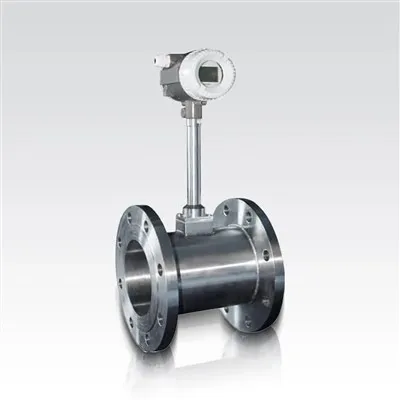
First off, let's talk a bit about what a Vortex Flowmeter is. A Vortex Flowmeter is a device used to measure the flow rate of fluids (liquids, gases, or steam) in a pipe. It works based on the principle of the von Kármán vortex street. When a fluid flows past a bluff body (a non - streamlined object) placed in the flow path, vortices are shed alternately from either side of the bluff body. The frequency of these vortex shedding is directly proportional to the flow velocity of the fluid.
Now, let's get into the nitty - gritty of calculating the flow rate. The basic formula for calculating the flow rate using a Vortex Flowmeter is:
$Q = f / K$
Where:
- $Q$ is the volumetric flow rate (in units like cubic meters per hour, $m^{3}/h$, or gallons per minute, GPM).
- $f$ is the frequency of vortex shedding (measured in Hertz, Hz).
- $K$ is the meter factor (in units of pulses per unit volume, e.g., pulses per cubic meter, $p/m^{3}$).
The meter factor $K$ is a calibration constant specific to each Vortex Flowmeter. It's determined during the calibration process at the factory. The calibration takes into account the physical characteristics of the flowmeter, such as the size of the bluff body and the internal diameter of the flow tube.
Let's say you've got a Vortex Flowmeter installed in a pipeline, and you measure the frequency of vortex shedding. You can simply divide this frequency by the meter factor to get the volumetric flow rate. For example, if the frequency of vortex shedding $f = 50$ Hz and the meter factor $K = 100$ pulses per cubic meter, then the volumetric flow rate $Q$ is:
$Q=\frac{50}{100}=0.5m^{3}/h$


But it's not always that straightforward. There are a few things you need to consider.
Temperature and Pressure Effects
The density of the fluid can change with temperature and pressure. For gases and steam, this is especially important. When the density changes, the relationship between the volumetric flow rate and the mass flow rate also changes. To account for this, you may need to measure the temperature and pressure of the fluid and use the ideal gas law or other appropriate equations to convert the volumetric flow rate to a mass flow rate.
The ideal gas law is given by:
$PV = nRT$
Where:
- $P$ is the pressure of the gas.
- $V$ is the volume of the gas.
- $n$ is the number of moles of the gas.
- $R$ is the ideal gas constant.
- $T$ is the absolute temperature of the gas.
If you know the pressure, temperature, and volumetric flow rate, you can calculate the mass flow rate using the density of the gas at the given conditions.
Viscosity and Reynolds Number
The viscosity of the fluid can also affect the performance of the Vortex Flowmeter. The Reynolds number ($Re$) is a dimensionless quantity that describes the flow regime (laminar or turbulent) and is given by:
$Re=\frac{\rho vD}{\mu}$
Where:
- $\rho$ is the density of the fluid.
- $v$ is the velocity of the fluid.
- $D$ is the diameter of the pipe.
- $\mu$ is the dynamic viscosity of the fluid.
Vortex Flowmeters work best in the turbulent flow regime, typically when the Reynolds number is above a certain value (usually around $10^{4}$). If the Reynolds number is too low, the vortex shedding may become unstable, and the flowmeter may not give accurate readings.
Installation Considerations
The installation of the Vortex Flowmeter can also impact the accuracy of the flow rate measurement. It should be installed in a straight section of the pipeline, away from any disturbances such as elbows, valves, or pumps. Upstream and downstream straight - run requirements are typically specified by the manufacturer. For example, a common requirement is to have at least 10 pipe diameters of straight pipe upstream and 5 pipe diameters downstream of the flowmeter.
Now, let's talk about some alternatives to Vortex Flowmeters. If you're in a situation where a Vortex Flowmeter might not be the best fit, you could consider other types of flowmeters. For instance, the LDG Electromagnetic Flowmeter is great for measuring the flow of conductive fluids. It works based on Faraday's law of electromagnetic induction. And the Turbine Flow Meter is another option. It measures the flow rate by counting the rotations of a turbine blade placed in the flow path.
But if you're dealing with a wide range of fluids (liquids, gases, and steam) and need a reliable and accurate flow measurement, a Vortex Flowmeter is often a top choice.
If you're interested in purchasing a Vortex Flowmeter or have any questions about calculating flow rates, feel free to reach out. We're here to help you find the right solution for your flow measurement needs. Whether you're in the chemical industry, food and beverage, or any other sector that requires accurate flow measurement, we've got the expertise and the products to meet your requirements.
References
- "Flow Measurement Handbook: Principles and Practice" by Richard W. Miller
- Manufacturer's documentation for Vortex Flowmeters