
How does a digital pressure gauge work?
Leave a message

Hey there! As a supplier of Digital Pressure Gauges, I often get asked about how these nifty devices work. So, I thought I'd break it down for you in a simple and easy - to - understand way.
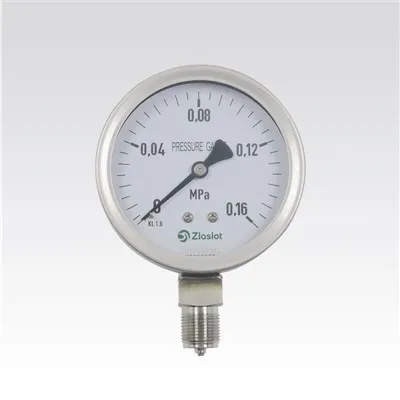
First off, let's talk about what a digital pressure gauge is. It's a tool that measures pressure and displays the reading digitally. Unlike Mechanical Presssure Gauge, which uses mechanical components like springs and gears to show the pressure, a digital pressure gauge uses electronic sensors to do the job.
The heart of a digital pressure gauge is its pressure sensor. There are different types of pressure sensors out there, but the most common ones used in digital pressure gauges are strain - gauge sensors and piezoelectric sensors.
Let's start with strain - gauge sensors. These sensors work based on the principle of strain. When pressure is applied to the sensor, it causes a deformation in a thin metal or semiconductor element. This deformation changes the electrical resistance of the element. You see, the strain - gauge is made up of a wire or a semiconductor material that's arranged in a specific pattern. When the sensor is under pressure, the wire or semiconductor gets stretched or compressed, which in turn changes its resistance.
The digital pressure gauge has a circuit that measures this change in resistance. It sends a small electrical current through the strain - gauge, and then it measures the voltage across it. Using Ohm's law (V = IR, where V is voltage, I is current, and R is resistance), the gauge can calculate the resistance. Since the change in resistance is proportional to the applied pressure, the gauge can then convert this resistance value into a pressure reading.
Now, piezoelectric sensors work a bit differently. Piezoelectric materials generate an electric charge when they're subjected to mechanical stress, like pressure. When pressure is applied to a piezoelectric crystal in the sensor, it creates a small electric charge. The digital pressure gauge's electronics detect this charge. The magnitude of the charge is directly related to the amount of pressure applied. The gauge then processes this electrical signal and converts it into a pressure value that can be displayed on the screen.
Once the sensor has measured the pressure and converted it into an electrical signal, the next step is signal conditioning. The electrical signal from the sensor is often very small and might be affected by noise. So, the gauge has a signal - conditioning circuit. This circuit amplifies the weak signal so that it's strong enough to be processed further. It also filters out any unwanted noise or interference that could distort the reading.
After signal conditioning, the processed signal goes to the microcontroller. The microcontroller is like the brain of the digital pressure gauge. It takes the amplified and filtered signal and performs some calculations. It uses pre - programmed algorithms to convert the electrical signal into a pressure value. For example, it might use a calibration curve that was set during the manufacturing process. This curve relates the electrical signal to the actual pressure.
Once the microcontroller has calculated the pressure value, it sends this information to the display. The display can be an LCD (Liquid Crystal Display) or an LED (Light - Emitting Diode) display. The pressure reading is then shown on the screen in units like psi (pounds per square inch), bar, or kPa (kilopascals), depending on how the gauge is set up.
One of the great things about digital pressure gauges is their accuracy. They can provide very precise readings compared to Mechanical Presssure Gauge. They're also more reliable over time because there are fewer moving parts that can wear out. And they can offer additional features like data logging. Some digital pressure gauges can store pressure readings over a period of time. This is really useful in applications where you need to monitor pressure changes over time, like in industrial processes or in testing equipment.
In industrial settings, digital pressure gauges are used in a wide range of applications. For example, in the oil and gas industry, they're used to measure the pressure in pipelines. They can also be found in hydraulic systems, where they help ensure that the system is operating at the correct pressure. In the food and beverage industry, digital pressure gauges are used to monitor the pressure in processing equipment to maintain quality control.
When it comes to high - temperature applications, High Temperature Mechanical Melt Presssure Gauges have been a go - to option for a long time. But digital pressure gauges are also making their mark. Digital Melt Presssure Gauges are designed to work in high - temperature environments. They use special sensors and materials that can withstand the heat. For instance, the sensors might be made of materials with high - temperature stability, and the electronics are often protected by heat - resistant coatings or enclosures.
If you're in the market for a digital pressure gauge, you'll want to consider a few things. First, think about the range of pressure you need to measure. Different gauges have different pressure ranges, so make sure you choose one that can handle the pressures in your application. Also, consider the accuracy you require. Some applications, like scientific research or high - precision manufacturing, need very accurate gauges.
Another factor is the environment where the gauge will be used. If it's a dirty or wet environment, you'll want a gauge that's rugged and has good protection against dust and moisture. You might also want to look at the display. A large, easy - to - read display is great, especially if you need to take readings from a distance.
Well, I hope this has given you a good understanding of how digital pressure gauges work. Whether you're in an industrial setting, a laboratory, or just need a gauge for a DIY project, a digital pressure gauge can be a great tool. And if you're interested in purchasing a digital pressure gauge, we're here to help. We offer a wide range of high - quality digital pressure gauges that are suitable for various applications. Don't hesitate to reach out for more information or to start a procurement discussion.
References


- "Pressure Measurement: Principles and Applications" by R. P. Dally, W. F. Riley, and K. G. McConnell
- "Instrumentation and Control Systems" by Alan S. Morris