How do thermal flowmeters measure gas flow?
Leave a message

Hey there! As a supplier of flowmeters, I often get asked about how different types of flowmeters work. Today, I'm gonna focus on thermal flowmeters and how they measure gas flow.
Understanding Gas Flow Measurement
Before we dive into thermal flowmeters, let's quickly talk about why measuring gas flow is important. In a bunch of industries like oil and gas, chemical processing, and environmental monitoring, knowing the accurate gas flow rate is crucial. It helps with process control, safety, and efficiency. For instance, in a chemical plant, the right gas flow rate ensures that reactions happen as they should. If the flow is too high or too low, it can mess up the entire process and even lead to safety hazards.
How Thermal Flowmeters Work
Okay, so how do thermal flowmeters do their job? Well, thermal flowmeters work on the principle of heat transfer. They have two main parts: a heated sensor and a reference sensor.
The basic idea is that when gas flows over the heated sensor, it takes away heat. The amount of heat taken away is directly related to the mass flow rate of the gas. The reference sensor, on the other hand, is not heated and is used to measure the ambient temperature of the gas.


Let's break it down a bit more. There are two common types of thermal flowmeters: constant temperature and constant power.
Constant Temperature Thermal Flowmeters
In a constant temperature thermal flowmeter, the temperature difference between the heated sensor and the reference sensor is kept constant. As the gas flows over the heated sensor and takes away heat, the meter automatically increases the power to the heated sensor to maintain that constant temperature difference. The power required to keep the temperature constant is proportional to the mass flow rate of the gas. So, by measuring the power input, we can figure out how much gas is flowing.
Constant Power Thermal Flowmeters
With constant power thermal flowmeters, a fixed amount of power is applied to the heated sensor. As the gas flows over it, the temperature of the heated sensor drops. The meter then measures the temperature difference between the heated sensor and the reference sensor. This temperature difference is related to the mass flow rate of the gas. The faster the gas flows, the more heat it takes away, and the bigger the temperature difference.
Advantages of Thermal Flowmeters for Gas Flow Measurement
There are several reasons why thermal flowmeters are a popular choice for measuring gas flow.
- Direct Mass Flow Measurement: Unlike some other flowmeters that measure volumetric flow and then need to be corrected for temperature and pressure changes to get mass flow, thermal flowmeters directly measure mass flow. This is really useful because mass flow is often what matters in industrial processes.
- High Sensitivity: Thermal flowmeters can detect very low flow rates. This makes them great for applications where even small changes in gas flow need to be monitored, like in laboratory settings or in leak detection systems.
- No Moving Parts: Since there are no moving parts in a thermal flowmeter, there's less wear and tear. This means lower maintenance costs and a longer lifespan compared to flowmeters with moving parts, like the Turbine Flow Meter.
Limitations of Thermal Flowmeters
Of course, no flowmeter is perfect, and thermal flowmeters have their limitations too.
- Gas Composition Sensitivity: Thermal flowmeters are sensitive to the composition of the gas. Different gases have different thermal properties, so if the gas composition changes, it can affect the accuracy of the measurement.
- Temperature and Pressure Effects: Although thermal flowmeters measure mass flow directly, extreme temperature and pressure conditions can still have an impact on their performance. In very high - temperature or high - pressure environments, the accuracy may decrease.
Applications of Thermal Flowmeters
Thermal flowmeters are used in a wide range of applications.
- Industrial Processes: In chemical plants, thermal flowmeters are used to measure the flow of gases like hydrogen, oxygen, and nitrogen. They help in controlling reactions and ensuring the quality of the final products.
- Environmental Monitoring: For measuring emissions of pollutants from factories or power plants, thermal flowmeters can accurately measure the flow of gases like carbon monoxide, sulfur dioxide, and methane.
- HVAC Systems: In heating, ventilation, and air - conditioning systems, thermal flowmeters are used to measure the flow of air. This helps in maintaining the right temperature and air quality in buildings.
Comparing Thermal Flowmeters with Other Types of Flowmeters
There are other types of flowmeters out there, like the Vortex Flowmeter and the LDG Electromagnetic Flowmeter. Let's see how thermal flowmeters stack up against them.
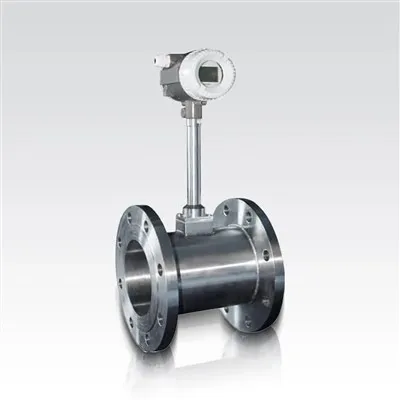
- Vortex Flowmeters: Vortex flowmeters work by measuring the frequency of vortices shed from a bluff body placed in the flow path. They are good for measuring high - flow rates of clean fluids, both gases and liquids. However, they are more suitable for volumetric flow measurement and may require additional calculations to get mass flow. Thermal flowmeters, on the other hand, directly measure mass flow and are better for low - flow applications.
- LDG Electromagnetic Flowmeters: These flowmeters work based on Faraday's law of electromagnetic induction and are mainly used for measuring the flow of conductive liquids. They are not suitable for gas flow measurement at all. So, when it comes to measuring gas flow, thermal flowmeters are a much better option.
Conclusion
So, there you have it! That's how thermal flowmeters measure gas flow. They're a great choice for many applications, thanks to their direct mass flow measurement, high sensitivity, and lack of moving parts. But they also have their limitations, like sensitivity to gas composition and extreme temperature and pressure conditions.
If you're in the market for a flowmeter to measure gas flow, I'd be more than happy to help you choose the right one for your specific needs. Whether it's a thermal flowmeter or another type, we have a wide range of options to suit different applications. Just reach out to us, and we can start a conversation about your requirements and how we can provide the best solution for you.
References
- Miller, R. W. (1983). Flow measurement engineering handbook. McGraw - Hill.
- Spitzer, D. W. (2001). Flow measurement: practical guides for measurement and control. ISA - The Instrumentation, Systems, and Automation Society.