
How do I choose the right pressure gauge for a compressor?
Leave a message

Choosing the right pressure gauge for a compressor is crucial for ensuring the efficient and safe operation of your equipment. As a pressure gauges supplier, I've seen firsthand the importance of making the right choice. In this blog, I'll share some tips on how to select the perfect pressure gauge for your compressor.
Understanding Your Compressor's Requirements
First things first, you need to understand your compressor's specific requirements. Different compressors operate at different pressure ranges, and you need a gauge that can accurately measure these pressures. For example, if you have a high - pressure compressor, you'll need a gauge with a high - pressure rating.
Let's say you're using a compressor for industrial applications. These compressors often operate at very high pressures, sometimes up to several thousand pounds per square inch (psi). In this case, you'll want a pressure gauge that can handle these high pressures without breaking or giving inaccurate readings.
On the other hand, if you're using a compressor for a small - scale project, like inflating tires or powering small pneumatic tools, the pressure requirements will be much lower. A gauge with a lower pressure range will be sufficient for this type of application.
Types of Pressure Gauges
There are several types of pressure gauges available on the market, and each has its own advantages and disadvantages.
Mechanical Pressure Gauges
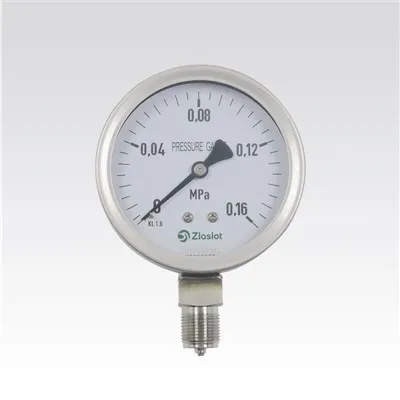
Mechanical pressure gauges are the most common type. They work based on the principle of mechanical deformation. When pressure is applied, a mechanical element, such as a Bourdon tube, bends or deforms, and this movement is translated into a reading on the gauge face.
These gauges are relatively simple and reliable. They don't require a power source, which makes them suitable for applications where power is not readily available. However, they can be less accurate than digital gauges, especially at very high or very low pressures.


Digital Pressure Gauges
Digital pressure gauges, on the other hand, use electronic sensors to measure pressure. They offer higher accuracy and can display the pressure reading in various units, such as psi, bar, or kPa. Digital gauges are also easier to read, especially in low - light conditions.
One of the great things about digital gauges is that they can often be connected to other devices, like computers or data loggers, for further analysis. However, they do require a power source, which can be a drawback in some applications.
If you're interested in digital gauges, you can check out our Digital Melt Presssure Gauges. These gauges are designed for applications where precise pressure measurement is required.
High - Temperature Pressure Gauges
For compressors that operate at high temperatures, you'll need a high - temperature pressure gauge. These gauges are designed to withstand the heat and still provide accurate pressure readings.
Our High Temperature Mechanical Melt Presssure Gauges are a great option for high - temperature applications. They are built with materials that can handle extreme heat and are engineered to provide reliable performance in harsh environments.
Vacuum Pressure Gauges
If your compressor operates in a vacuum environment, you'll need a vacuum pressure gauge. These gauges are designed to measure pressures below atmospheric pressure.
Our Vacuum Digital Pressure Gauge is specifically designed for vacuum applications. It offers high accuracy and is easy to use.
Consider the Accuracy and Resolution
Accuracy is a critical factor when choosing a pressure gauge. You want a gauge that can provide accurate readings within a certain tolerance. The accuracy of a pressure gauge is usually expressed as a percentage of the full - scale reading. For example, a gauge with an accuracy of ±1% means that the reading can be off by up to 1% of the full - scale value.
Resolution is another important consideration. Resolution refers to the smallest change in pressure that the gauge can detect. A gauge with a high resolution can provide more detailed pressure readings.
Installation and Mounting
The way you install and mount the pressure gauge can also affect its performance. Make sure to follow the manufacturer's instructions carefully. The gauge should be installed in a location where it is easily accessible for reading and maintenance.
It's also important to ensure that the gauge is properly connected to the compressor. A loose or incorrect connection can lead to inaccurate readings or even damage to the gauge.
Maintenance and Calibration
Regular maintenance and calibration are essential for keeping your pressure gauge in good working condition. Over time, the accuracy of a pressure gauge can drift, so it's important to have it calibrated periodically.
Most manufacturers recommend calibrating pressure gauges at least once a year. You can either send the gauge back to the manufacturer for calibration or use a calibration device to do it yourself.
Cost
Cost is always a factor when making a purchasing decision. While you don't want to skimp on quality, you also don't want to overspend. Compare the prices of different pressure gauges and consider the features and performance they offer.
In some cases, it may be worth investing a little more in a high - quality gauge that will last longer and provide more accurate readings. However, if you're on a tight budget, there are also some affordable options available that can still meet your basic needs.
Conclusion
Choosing the right pressure gauge for your compressor is not a decision to be taken lightly. By understanding your compressor's requirements, considering the different types of gauges available, and taking into account factors like accuracy, installation, maintenance, and cost, you can make an informed decision.
If you're still unsure which pressure gauge is right for you, don't hesitate to reach out. As a pressure gauges supplier, we have the expertise and experience to help you find the perfect gauge for your application. Contact us today to start the procurement discussion and get the best pressure gauge for your compressor.
References
- Compressor Handbook, various editions
- Pressure Gauge Manufacturer's Guides