How do melt pressure gauges work in a thermoforming process?
Leave a message

In the dynamic world of thermoforming, precision and control are the cornerstones of high - quality production. One of the critical components in ensuring this precision is the melt pressure gauge. As a leading supplier of melt pressure gauges, we understand the pivotal role these instruments play in the thermoforming process. In this blog, we will delve into the inner workings of melt pressure gauges, exploring how they function and why they are indispensable in thermoforming.
Understanding the Thermoforming Process
Before we dive into the details of melt pressure gauges, it's essential to have a basic understanding of the thermoforming process. Thermoforming is a manufacturing method where a plastic sheet is heated to a pliable forming temperature, formed to a specific shape in a mold, and trimmed to create a usable product. This process is widely used in various industries, including packaging, automotive, and consumer goods, due to its versatility and cost - effectiveness.
The key steps in thermoforming include heating the plastic sheet, forming it into the desired shape using a mold (either through vacuum, pressure, or mechanical means), cooling the formed part to set its shape, and then trimming the excess material. Throughout this process, maintaining the correct pressure of the molten plastic is crucial for achieving consistent product quality.
The Role of Melt Pressure Gauges in Thermoforming
Melt pressure gauges are used to measure the pressure of the molten plastic during the thermoforming process. This measurement is vital for several reasons. Firstly, it helps in ensuring that the plastic is flowing through the system at the correct pressure. If the pressure is too low, the plastic may not fill the mold completely, leading to incomplete parts or parts with thin sections. On the other hand, if the pressure is too high, it can cause excessive stress on the mold, leading to premature wear and tear, and may even result in the plastic leaking out of the mold.


Secondly, accurate pressure measurement allows for better control of the thermoforming process. By monitoring the pressure, operators can make real - time adjustments to the process parameters, such as the temperature of the plastic, the speed of the forming mechanism, or the pressure applied by the mold. This helps in maintaining a consistent product quality and reducing the number of defective parts.
How Melt Pressure Gauges Work
There are two main types of melt pressure gauges commonly used in thermoforming: mechanical and digital. Let's explore how each of these types works.
Mechanical Pressure Gauges
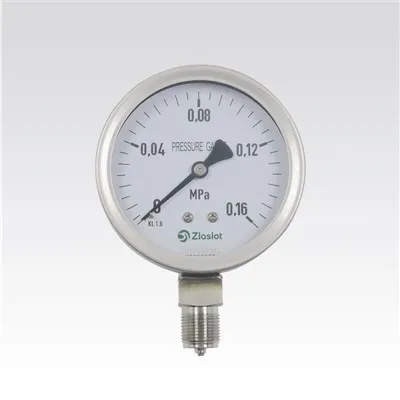
Mechanical pressure gauges, such as the Mechanical Presssure Gauge, are based on the principle of mechanical deformation. The most common type of mechanical pressure gauge used in thermoforming is the Bourdon tube gauge.
The Bourdon tube is a curved, hollow tube that is typically made of metal. When pressure is applied to the inside of the tube, the tube tries to straighten out due to the internal pressure. This mechanical movement is transferred to a pointer through a series of gears and linkages. As the tube moves, the pointer rotates around a dial, indicating the pressure on the scale.
In a thermoforming application, the Bourdon tube is connected to a pressure tap in the plastic extrusion or injection system. As the molten plastic flows through the system, the pressure of the plastic acts on the inside of the Bourdon tube, causing it to deform and the pointer to move. The gauge is calibrated to display the pressure in the appropriate units, such as pounds per square inch (psi) or megapascals (MPa).
High Temperature Mechanical Melt Pressure Gauges
In thermoforming processes, the plastic is typically heated to high temperatures, often well above 200°C. To withstand these high temperatures, High Temperature Mechanical Melt Presssure Gauges are used. These gauges are designed with special materials and construction techniques to ensure reliable operation in high - temperature environments.
The Bourdon tube in a high - temperature mechanical melt pressure gauge is usually made of a high - nickel alloy or a stainless steel that can resist the effects of high temperatures and chemical corrosion. Additionally, the gauge may be equipped with a cooling element, such as a cooling fin or a water - cooled jacket, to prevent the internal components from overheating.
Digital Melt Pressure Gauges
Digital melt pressure gauges, such as the Digital Melt Presssure Gauges, offer a more advanced and precise way of measuring pressure. These gauges use a pressure sensor, typically a strain - gauge or a piezoelectric sensor, to convert the pressure into an electrical signal.
A strain - gauge sensor consists of a thin metal foil or wire that is bonded to a diaphragm. When pressure is applied to the diaphragm, it deforms, causing a change in the resistance of the strain - gauge. This change in resistance is then measured by an electrical circuit and converted into a digital signal.
A piezoelectric sensor, on the other hand, generates an electrical charge when it is subjected to pressure. The magnitude of the electrical charge is proportional to the applied pressure. The sensor's electrical signal is then processed by a microprocessor, which displays the pressure value on a digital display in a clear and easy - to - read format.
Digital melt pressure gauges offer several advantages over mechanical gauges. They are more accurate, with a higher resolution and less susceptibility to mechanical wear and tear. They can also provide additional features, such as data logging, alarm functions, and remote monitoring capabilities, which can greatly enhance the control and efficiency of the thermoforming process.
Installation and Maintenance of Melt Pressure Gauges
Proper installation and maintenance of melt pressure gauges are essential for accurate and reliable operation. When installing a melt pressure gauge, it is important to ensure that it is properly connected to the pressure tap in the thermoforming system. The connection should be leak - proof to prevent any loss of pressure or contamination of the system.
Regular maintenance of melt pressure gauges is also necessary. For mechanical gauges, this may include checking the pointer for proper movement, cleaning the gauge to remove any debris or plastic residue, and calibrating the gauge periodically to ensure its accuracy. For digital gauges, in addition to cleaning and calibration, it is important to check the battery (if applicable) and the integrity of the electrical connections.
Why Choose Our Melt Pressure Gauges
As a trusted supplier of melt pressure gauges, we offer a wide range of products to meet the diverse needs of the thermoforming industry. Our mechanical pressure gauges are built with high - quality materials and precision engineering, ensuring reliable performance even in the most demanding applications. Our high - temperature mechanical melt pressure gauges are designed to withstand extreme temperatures and harsh chemical environments, providing long - lasting and accurate pressure measurement.
Our digital melt pressure gauges, on the other hand, offer the latest in sensor technology and digital signal processing. They are easy to install, operate, and integrate with existing control systems. With features such as data logging and alarm functions, our digital gauges can help you optimize your thermoforming process and improve your product quality.
Contact Us for Your Melt Pressure Gauge Needs
If you are in the thermoforming industry and are looking for high - quality melt pressure gauges, we invite you to contact us. Our team of experts is ready to assist you in selecting the right gauge for your specific application. We can provide you with detailed product information, technical support, and competitive pricing. Whether you need a single gauge or a complete set of pressure measurement solutions, we have you covered. Start the conversation today and take the first step towards enhancing the precision and efficiency of your thermoforming process.
References
- "Plastics Processing Handbook" by O. Olabisi and K. K. Dey.
- "Thermoforming Technology" by J. L. Throne.
- Manufacturer's documentation for melt pressure gauges.