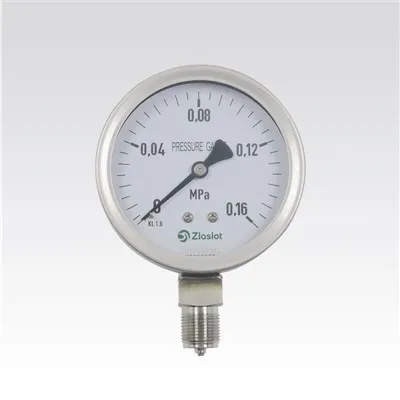

What is the working principle of melt pressure gauges?
Leave a message

Hey there! As a supplier of Melt Pressure Gauges, I often get asked about how these nifty devices work. So, I thought I'd take a moment to break down the working principle of melt pressure gauges for you.
What Are Melt Pressure Gauges?
First things first, let's talk about what melt pressure gauges are. These are specialized instruments used in various industries, especially in plastics processing, extrusion, and injection molding. Their main job is to measure the pressure of molten materials, like plastics or polymers, as they're being processed. This is super important because the right pressure is crucial for getting high - quality products.
The Basic Working Principle
At the heart of a melt pressure gauge is the concept of converting pressure into a measurable signal. Most melt pressure gauges work based on the deformation of a sensing element when it's exposed to pressure.
Let's start with the mechanical part. When the molten material presses against the sensing element of the gauge, it causes a physical change. For example, in some Mechanical Presssure Gauge, there's a Bourdon tube. This is a curved, hollow tube. When pressure is applied to the inside of the tube, it tries to straighten out. This movement is then transferred through a mechanical linkage to a pointer on the gauge face. As the tube moves, the pointer rotates, showing the pressure reading on a calibrated scale.
Strain Gauge Technology
A lot of modern melt pressure gauges use strain gauge technology. Strain gauges are small, thin devices made of a conductive material. They're attached to the sensing element of the gauge. When the sensing element is deformed by the pressure of the molten material, the strain gauge also gets stretched or compressed.
This change in shape of the strain gauge causes a change in its electrical resistance. The relationship between the deformation and the change in resistance is well - defined. The gauge has an electrical circuit that measures this change in resistance. This electrical signal is then processed and converted into a pressure reading.
The great thing about strain gauge - based melt pressure gauges is that they can be very accurate. They can also be made into digital gauges, like Digital Melt Presssure Gauges. These digital gauges can display the pressure reading in a clear, easy - to - read format, and they can also be connected to other systems for data logging or control.
Piezoelectric Technology
Another technology used in some melt pressure gauges is piezoelectric technology. Piezoelectric materials generate an electric charge when they're subjected to mechanical stress, like the pressure from the molten material.
In a piezoelectric melt pressure gauge, the sensing element is made of a piezoelectric crystal. When the molten material presses against the crystal, it generates a small electric charge. This charge is proportional to the pressure applied. The gauge then measures this electric charge and converts it into a pressure reading.
Piezoelectric gauges are really fast - responding. They can detect very rapid changes in pressure, which is useful in applications where the pressure can change quickly, like in high - speed injection molding.
Installation and Considerations
When installing a melt pressure gauge, there are a few things to keep in mind. First, the gauge needs to be installed in the right place. It should be in direct contact with the molten material so that it can accurately measure the pressure.
The temperature of the molten material is also a big factor. Most melt pressure gauges are designed to work within a certain temperature range. If the temperature is too high, it can affect the performance of the gauge, especially the electrical components in digital gauges. Some gauges come with special temperature compensation features to deal with this.
Vacuum and Negative Pressure
In some processes, there might be a need to measure vacuum or negative pressure. That's where Vacuum Digital Pressure Gauge come in. These gauges work on similar principles as regular melt pressure gauges, but they're designed to measure pressures below atmospheric pressure.
When measuring vacuum, the sensing element of the gauge is designed to respond to the difference between the pressure inside the system and the atmospheric pressure. The gauge then displays the vacuum level, which is usually measured in units like millimeters of mercury (mmHg) or pascals (Pa).


Maintenance and Calibration
To keep your melt pressure gauges working accurately, regular maintenance and calibration are essential. Over time, the sensing element can wear out or get damaged, especially in harsh industrial environments.
Calibration involves comparing the readings of the gauge with a known standard pressure. If there's a difference, the gauge needs to be adjusted so that its readings are accurate. Most manufacturers recommend calibrating melt pressure gauges at regular intervals, like once a year or more frequently depending on the usage.
Why Choose Our Melt Pressure Gauges
As a supplier of melt pressure gauges, we offer a wide range of products to suit different needs. Our gauges are made with high - quality materials and advanced technology. Whether you need a simple mechanical gauge for a basic application or a sophisticated digital gauge for a high - precision process, we've got you covered.
Our team of experts can also help you with installation, maintenance, and calibration. We understand that every customer's situation is unique, and we're committed to providing the best solutions for your specific requirements.
If you're in the market for melt pressure gauges, or if you have any questions about how they work or which one is right for your application, don't hesitate to get in touch. We're here to assist you with all your melt pressure gauge needs. Contact us today to start the conversation about your purchase and find the perfect gauge for your business.
References
- "Pressure Measurement Handbook" by John W. Rose
- "Industrial Instrumentation and Control" by B.C. Nakra and K.K. Chaudhry