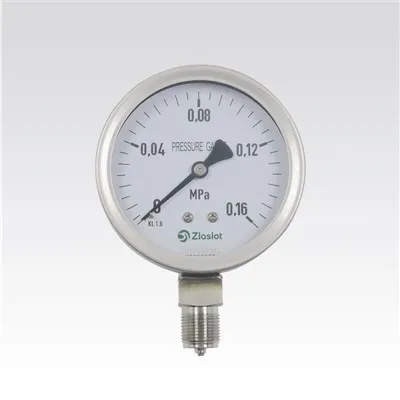

What is the sensitivity of a Homogenizer Pressure Gauge?
Leave a message

Hey there! As a supplier of Homogenizer Pressure Gauges, I often get asked about the sensitivity of these nifty devices. So, let's dive right in and break down what sensitivity really means in the context of a Homogenizer Pressure Gauge.
What is Sensitivity Anyway?
Sensitivity, in simple terms, is how well a pressure gauge can detect and show small changes in pressure. Think of it like your car's speedometer. If it's super sensitive, it can accurately show even the tiniest increase or decrease in your speed. In the same way, a highly sensitive Homogenizer Pressure Gauge can pick up on small fluctuations in pressure within a homogenizer.


Now, why is this so important? Well, in the world of homogenization, precise pressure control is key. Homogenizers are used in a bunch of industries, like food and beverage, pharmaceuticals, and cosmetics. In these industries, getting the pressure just right is crucial for the quality of the final product. For example, in the food industry, homogenization helps to mix ingredients evenly, giving products a smooth texture. If the pressure isn't controlled properly, the end product might not have the right consistency, and that's a big no - no.
How Sensitivity Affects Homogenization
Let's say you're making a high - end lotion in the cosmetics industry. You want all the ingredients to blend together perfectly to create a luxurious, smooth product. A Homogenizer Pressure Gauge with high sensitivity can ensure that the pressure during the homogenization process stays within the ideal range. It can detect if the pressure drops a little bit, which might happen due to a clog in the system or a change in the flow rate of the ingredients. With this early detection, you can make adjustments right away, preventing any issues with the final product.
On the other hand, a less sensitive gauge might not pick up on these small pressure changes. As a result, you could end up with a lotion that has an uneven texture, with some parts being too thick and others too thin. This not only affects the quality of the product but also the brand's reputation.
Factors Affecting Sensitivity
There are a few things that can impact the sensitivity of a Homogenizer Pressure Gauge. One of the main factors is the gauge's design. Some gauges are built with more precise internal components, like diaphragms or Bourdon tubes, which can better detect small pressure changes. These high - precision components are often made from high - quality materials that are more responsive to pressure variations.
Another factor is the calibration of the gauge. Just like you need to set your watch to the correct time, a pressure gauge needs to be calibrated regularly to ensure accurate readings. Over time, the internal components of a gauge can wear out or shift slightly, which can affect its sensitivity. Regular calibration helps to keep the gauge in top - notch condition and ensures that it can accurately measure pressure.
The environment in which the gauge is used also plays a role. If the gauge is exposed to extreme temperatures, vibrations, or corrosive substances, it can damage the internal components and reduce its sensitivity. That's why it's important to choose a gauge that is suitable for the specific operating conditions of your homogenizer.
Types of Homogenizer Pressure Gauges and Their Sensitivity
There are different types of Homogenizer Pressure Gauges, and each type has its own level of sensitivity.
Vacuum Digital Pressure Gauge
The Vacuum Digital Pressure Gauge is known for its high sensitivity. These gauges use digital technology to measure pressure, which allows for very precise readings. Digital gauges can display pressure values with a high level of accuracy, often down to a few decimal places. They are also more resistant to environmental factors like vibrations, as they don't have as many moving parts as mechanical gauges. This makes them a great choice for applications where high sensitivity is required.
Mechanical Presssure Gauge
Mechanical Presssure Gauge are another common type. These gauges use mechanical components like Bourdon tubes or diaphragms to measure pressure. While they are generally reliable, their sensitivity can vary depending on the quality of the components and the design of the gauge. High - quality mechanical gauges can have good sensitivity, but they might be more affected by environmental factors like temperature and vibrations compared to digital gauges.
High Temperature Mechanical Melt Presssure Gauges
High Temperature Mechanical Melt Presssure Gauges are designed for use in high - temperature environments, such as in the plastics or rubber industries. These gauges need to be able to withstand extreme heat while still providing accurate pressure readings. Their sensitivity can be a bit lower compared to digital gauges, but they are built to handle the harsh conditions of high - temperature applications.
Choosing the Right Sensitivity for Your Needs
When it comes to choosing a Homogenizer Pressure Gauge, it's important to consider your specific needs. If you're working in an industry where even the smallest pressure changes can have a big impact on the product quality, like in the pharmaceutical industry, you'll probably want a gauge with high sensitivity, such as a digital gauge.
On the other hand, if your application is less sensitive to pressure variations and you're working in a more rugged environment, a mechanical gauge might be a better choice. It's also important to consider the cost. Generally, high - sensitivity gauges, especially digital ones, can be more expensive than mechanical gauges. So, you need to find the right balance between sensitivity and cost for your business.
Conclusion
In conclusion, the sensitivity of a Homogenizer Pressure Gauge is a crucial factor in ensuring the success of your homogenization process. Whether you're making delicious food products, life - saving pharmaceuticals, or luxurious cosmetics, a gauge with the right sensitivity can make all the difference.
If you're in the market for a Homogenizer Pressure Gauge and want to learn more about the best options for your specific needs, don't hesitate to reach out. We're here to help you find the perfect gauge to keep your homogenization process running smoothly.
References
- "Pressure Gauge Handbook" by Instrumentation Engineers
- "Homogenization Technology in the Food Industry" by Food Science Journal
- "Cosmetic Manufacturing and Pressure Control" by Cosmetics Industry Magazine