
What is the optimal blade angle for a Turbine Flow Meter?
Leave a message

Hey there! As a supplier of Turbine Flow Meters, I often get asked, "What is the optimal blade angle for a Turbine Flow Meter?" Well, let's dive right into this topic and break it down.
First off, let's understand what a Turbine Flow Meter does. A Turbine Flow Meter is a device used to measure the flow rate of fluids in a pipeline. It works on the principle that the fluid flowing through the meter causes a turbine to rotate, and the speed of this rotation is proportional to the flow rate of the fluid. The blade angle of the turbine is a crucial factor that can significantly affect the performance of the meter.


So, what exactly is the blade angle? The blade angle is the angle at which the blades of the turbine are set relative to the direction of the fluid flow. This angle can vary depending on several factors, including the type of fluid being measured, the flow rate range, and the viscosity of the fluid.
One of the main reasons why the blade angle is so important is that it affects the torque exerted on the turbine. Torque is the force that causes the turbine to rotate. If the blade angle is too small, the fluid may not be able to exert enough torque on the turbine, resulting in inaccurate flow rate measurements. On the other hand, if the blade angle is too large, the turbine may experience excessive drag, which can also lead to inaccurate readings and may even cause damage to the meter over time.
Let's talk about the relationship between the blade angle and the flow rate. In general, for low flow rates, a larger blade angle is preferred. This is because at low flow rates, the fluid has less energy, and a larger blade angle allows the fluid to exert more torque on the turbine, ensuring that it rotates smoothly and accurately measures the flow rate. For example, if you're measuring the flow of a viscous fluid at a low flow rate, a blade angle of around 45 to 60 degrees might be optimal.
Conversely, at high flow rates, a smaller blade angle is often better. At high flow speeds, the fluid has a lot of energy, and a smaller blade angle reduces the drag on the turbine, preventing it from rotating too fast and causing over - speeding. A blade angle in the range of 20 to 30 degrees might be suitable for high - flow applications, especially when dealing with less viscous fluids.
The viscosity of the fluid also plays a huge role in determining the optimal blade angle. Viscous fluids, like oil, have a higher resistance to flow compared to less viscous fluids like water. When measuring the flow of viscous fluids, a larger blade angle is usually necessary to ensure that the fluid can effectively turn the turbine. The larger angle allows the fluid to have more surface area to act on the blades, generating enough torque for rotation.
Another factor to consider is the accuracy requirements of the measurement. If you need highly accurate flow rate measurements, you'll need to carefully select the blade angle based on the specific conditions of your application. In some cases, you might even need to conduct some tests to find the optimal angle.
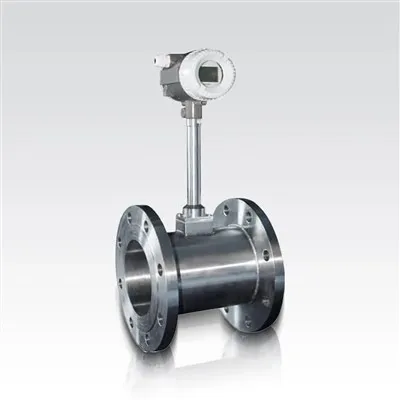
Now, how does the blade angle compare to other types of flow meters? Let's take a look at the LDG Electromagnetic Flowmeter and the Vortex Flowmeter. The LDG Electromagnetic Flowmeter measures flow rate based on Faraday's law of electromagnetic induction and doesn't rely on moving parts like a turbine. So, the concept of a blade angle doesn't apply to it. The Vortex Flowmeter, on the other hand, measures flow rate by detecting the frequency of vortices shed from a bluff body in the flow path. It also doesn't have a turbine blade, so the blade angle isn't relevant here.
As a Turbine Flow Meter supplier, we've seen a wide range of applications, and we know that finding the optimal blade angle is a balancing act. We work closely with our customers to understand their specific needs, whether it's measuring the flow of chemicals in a manufacturing plant, water in a municipal supply, or oil in a refinery.
We offer a variety of Turbine Flow Meters with different blade angles to suit different applications. Our team of experts can help you select the right meter and the optimal blade angle for your particular situation. We also provide installation and maintenance services to ensure that your flow meter continues to perform accurately over time.
If you're in the market for a Turbine Flow Meter or want to learn more about how the blade angle can impact your measurements, don't hesitate to get in touch. We're here to assist you in making the best choice for your flow measurement needs. Whether you're a small - scale operation or a large industrial facility, we have the solutions to meet your requirements.
In conclusion, the optimal blade angle for a Turbine Flow Meter depends on a variety of factors, including the flow rate, fluid viscosity, and accuracy requirements. By carefully considering these factors and working with a reliable supplier, you can ensure that your Turbine Flow Meter provides accurate and reliable flow rate measurements.
References
- "Flow Measurement Handbook: Industrial Designs, Operating Principles, Performance, and Applications" by Richard W. Miller
- "Instrumentation and Control Systems" by Alan S. Morris