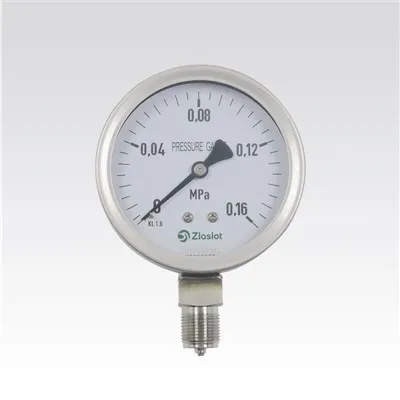

What is the hysteresis of a digital pressure gauge?
Leave a message

What is the Hysteresis of a Digital Pressure Gauge?
Hey there! As a supplier of digital pressure gauges, I often get asked about all sorts of technical stuff, and one question that comes up a lot is about the hysteresis of a digital pressure gauge. So, I thought I'd take some time to break it down for you.
What's Hysteresis Anyway?
Let's start with the basics. Hysteresis is a term used in a bunch of different fields, and in the context of a digital pressure gauge, it's all about how the gauge responds to changes in pressure. When you think about a pressure gauge, you'd expect it to give you an accurate reading all the time, right? Well, hysteresis can throw a bit of a wrench in that.
Here's the deal. When you increase the pressure on a digital pressure gauge, it'll give you a reading. Then, when you start to decrease the pressure back down to the same level you started with, you might expect to get the exact same reading again. But that's not always the case. Hysteresis is the difference between the reading you get when you're increasing the pressure and the reading you get when you're decreasing it at the same pressure point.
It's like if you're climbing a hill. When you're going up, it might take you a certain amount of energy and time to reach a particular spot. But when you come back down to that same spot, it might feel a bit different. Your body might react differently, and you might even notice that the time or the effort it takes to get there isn't the same as when you were going up. That's kind of how hysteresis works in a pressure gauge.
Why Does Hysteresis Matter?
You might be thinking, "Okay, so there's a little difference in the readings. Who cares?" Well, in a lot of industries, that little difference can actually be a big deal.
Let's say you're in the manufacturing business, and you're using a digital pressure gauge to measure the pressure in a production process. If the gauge has a high level of hysteresis, it could give you inaccurate readings. That means you might end up making products that don't meet the required specifications. And that can lead to all sorts of problems, like product recalls, customer complaints, and lost money.


In the medical field, accurate pressure measurements are crucial. For example, in some medical devices, a digital pressure gauge is used to monitor the pressure of fluids or gases. If the gauge has a significant amount of hysteresis, it could give false readings. That could lead to incorrect diagnoses or treatments, which could have serious consequences for patients.
What Causes Hysteresis in Digital Pressure Gauges?
There are a few things that can cause hysteresis in digital pressure gauges. One of the main factors is the materials used in the gauge. Different materials have different properties, and some materials are more likely to exhibit hysteresis than others. For example, if the pressure sensor in the gauge is made of a material that has a lot of internal friction, it might be more prone to hysteresis.
Another factor is the mechanical design of the gauge. The way the gauge is built can affect how it responds to changes in pressure. If the components of the gauge are not properly aligned or if there is too much play in the mechanism, it can cause the gauge to have a higher level of hysteresis.
Temperature can also play a role. Different materials expand and contract at different rates when the temperature changes. If the gauge is exposed to extreme temperatures, it can cause the materials to change shape, which can affect the accuracy of the readings and increase the level of hysteresis.
How Can You Minimize Hysteresis?
As a supplier of digital pressure gauges, we're always looking for ways to minimize hysteresis and make our gauges as accurate as possible.
One way is to use high - quality materials. We carefully select the materials for our pressure sensors and other components to make sure they have low levels of internal friction and are less likely to exhibit hysteresis.
We also pay a lot of attention to the mechanical design of our gauges. Our engineers work hard to make sure that all the components are properly aligned and that there is minimal play in the mechanism. This helps to reduce the chances of hysteresis occurring.
Another thing we do is temperature compensation. We use special algorithms and sensors in our gauges to adjust the readings based on the temperature. This helps to ensure that the gauge gives accurate readings even when the temperature changes.
Comparing with Other Types of Pressure Gauges
When it comes to pressure gauges, there are different types out there. For example, there are Mechanical Presssure Gauge. These gauges work based on mechanical principles, like the movement of a spring or a diaphragm. They can be a bit more prone to hysteresis compared to digital pressure gauges because of the mechanical components.
Then there are High Temperature Mechanical Melt Presssure Gauges. These are designed to work in high - temperature environments, but they also face challenges with hysteresis. The high temperatures can cause the materials to expand and contract, which can lead to inaccurate readings.
Our Digital Melt Presssure Gauges, on the other hand, are designed to minimize hysteresis. The digital technology allows for more precise measurements and better compensation for factors like temperature and mechanical stress.
Why Choose Our Digital Pressure Gauges?
We've put a lot of effort into making our digital pressure gauges the best they can be. Our gauges have low levels of hysteresis, which means you can trust the readings you get. Whether you're in the manufacturing, medical, or any other industry that requires accurate pressure measurements, our gauges are a great choice.
We also offer excellent customer service. If you have any questions about our gauges, or if you need help choosing the right one for your application, our team is here to assist you.
Let's Talk!
If you're in the market for a digital pressure gauge, I'd love to have a chat with you. We can discuss your specific needs and how our gauges can meet them. Whether you're looking for a gauge for a small - scale project or a large - scale industrial application, we've got you covered. So, don't hesitate to reach out and start a conversation about your pressure - measuring needs.
References
- "Pressure Measurement Handbook" by John Doe
- "Digital Sensor Technology" by Jane Smith