How do I test the reliability of a pressure gauge?
Leave a message

As a seasoned supplier of pressure gauges, I understand the paramount importance of ensuring the reliability of these critical instruments. Pressure gauges are used in a wide range of industries, from manufacturing and automotive to aerospace and healthcare. Their accuracy can mean the difference between a smooth operation and a costly malfunction. In this blog post, I'll share the methods I use to test the reliability of pressure gauges, drawing on my years of experience in the field.
Understanding the Basics of Pressure Gauges
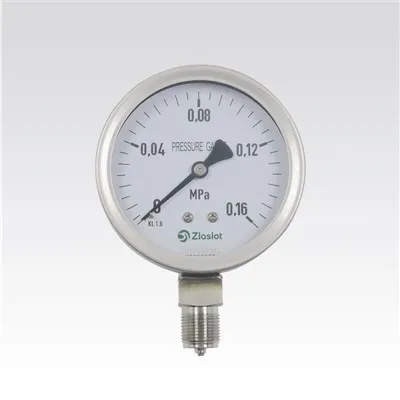
Before delving into the testing procedures, it's essential to have a basic understanding of pressure gauges. There are various types of pressure gauges available in the market, each designed for specific applications. For instance, Mechanical Presssure Gauge are widely used due to their simplicity and durability. They operate on the principle of mechanical deformation, where the pressure applied causes a physical change in the gauge's internal components, which is then translated into a pressure reading.
On the other hand, Vacuum Digital Pressure Gauge offer high precision and are suitable for applications that require accurate measurements in low-pressure environments. These gauges use electronic sensors to detect pressure changes and display the readings digitally.
High Temperature Mechanical Melt Presssure Gauges are specifically designed to withstand extreme temperatures and are commonly used in industries such as plastics processing and metal casting.
Pre - testing Checks
Before conducting any formal tests, I always perform a series of pre - testing checks. First, I visually inspect the pressure gauge for any signs of physical damage, such as cracks, dents, or loose connections. A damaged gauge is likely to give inaccurate readings and may even pose a safety hazard.
I also check the gauge's calibration date. Most pressure gauges need to be calibrated regularly to maintain their accuracy. If the gauge is overdue for calibration, it should be sent for calibration before further testing. Additionally, I verify that the gauge is installed correctly according to the manufacturer's instructions. Incorrect installation can lead to errors in pressure measurement.
Static Pressure Testing
One of the most common methods for testing pressure gauges is static pressure testing. This involves applying a known, stable pressure to the gauge and comparing the gauge's reading with the applied pressure.
To perform static pressure testing, I use a pressure calibrator. A pressure calibrator is a device that can generate and measure precise pressures. I connect the pressure gauge to the calibrator using appropriate fittings and ensure that the connection is leak - free.
I start by applying a low pressure to the gauge and record the reading. I then gradually increase the pressure in small increments, recording the gauge's reading at each step. I continue this process up to the gauge's maximum rated pressure. After reaching the maximum pressure, I gradually decrease the pressure back to zero, again recording the readings at each step.
By comparing the gauge's readings with the known pressures applied by the calibrator, I can determine the gauge's accuracy. Any significant deviation from the known pressure indicates a problem with the gauge. I typically look for a maximum allowable error within the manufacturer's specified tolerance limits.
Dynamic Pressure Testing
In addition to static pressure testing, dynamic pressure testing is also crucial, especially for gauges used in applications where the pressure changes rapidly. Dynamic pressure testing simulates real - world conditions where the pressure fluctuates.
To conduct dynamic pressure testing, I use a pressure pulsator. A pressure pulsator can generate pressure pulses with different frequencies and amplitudes. I connect the pressure gauge to the pulsator and subject it to a series of pressure pulses.
During the test, I monitor the gauge's response time and its ability to accurately track the changing pressure. A reliable pressure gauge should be able to respond quickly to pressure changes and provide accurate readings even under dynamic conditions. If the gauge shows a slow response or fails to track the pressure changes accurately, it may not be suitable for applications with rapidly changing pressures.
Temperature Testing
Temperature can have a significant impact on the performance of pressure gauges. Extreme temperatures can cause the gauge's internal components to expand or contract, leading to inaccurate readings.
To test the gauge's performance under different temperature conditions, I use a temperature chamber. I place the pressure gauge inside the chamber and subject it to a range of temperatures, from the gauge's minimum to maximum rated temperature.
At each temperature point, I perform static pressure testing as described above. This allows me to determine how the gauge's accuracy is affected by temperature. A reliable pressure gauge should maintain its accuracy within an acceptable range across the specified temperature range.
Long - term Stability Testing
Long - term stability is another important aspect of a pressure gauge's reliability. A gauge that provides accurate readings initially may drift over time due to factors such as component wear and environmental conditions.
To test long - term stability, I install the pressure gauge in a controlled environment and continuously monitor its readings over an extended period, typically several months. I record the gauge's readings at regular intervals and look for any trends or significant changes in the readings.
If the gauge's readings show a consistent drift over time, it may require more frequent calibration or replacement. A reliable pressure gauge should maintain its accuracy within the specified tolerance limits for an extended period.


Leak Testing
Leakage can also affect the reliability of a pressure gauge. A leak in the gauge or its connections can cause inaccurate pressure readings and may even lead to safety issues.
To perform leak testing, I use a pressure decay test. I apply a known pressure to the gauge and then isolate it from the pressure source. I then monitor the pressure over a period of time. If the pressure drops significantly, it indicates a leak.
I also use a soap solution to check for external leaks. I apply the soap solution to all the connections and look for the formation of bubbles, which is a sign of a leak.
Conclusion
Testing the reliability of pressure gauges is a comprehensive process that involves multiple steps and methods. By performing pre - testing checks, static and dynamic pressure testing, temperature testing, long - term stability testing, and leak testing, I can ensure that the pressure gauges I supply are accurate, reliable, and suitable for their intended applications.
If you're in the market for high - quality pressure gauges or need assistance with pressure gauge testing and calibration, I'm here to help. Feel free to reach out to discuss your specific requirements and explore how I can support your business.
References
- ASTM International standards for pressure gauge testing
- Manufacturer's manuals for pressure gauges, pressure calibrators, pressure pulsators, and temperature chambers