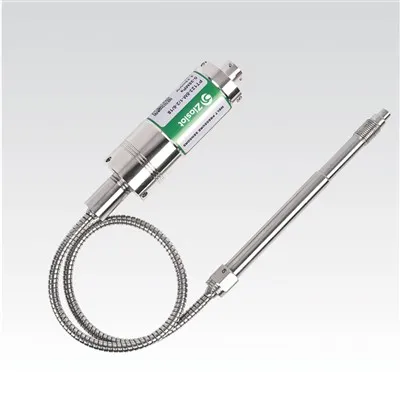
What is a pressure transmitter
Leave a message
A pressure transmitter is a device that converts pressure into pneumatic or electric signals for control and remote transmission.
It can convert the physical pressure parameters such as gas and liquid sensed by the pressure measuring element sensor into standard electrical signals (such as 4-20mADC), to supply secondary instruments such as indicator alarms, recorders, regulators, etc. for measurement, indication, and process adjustment.
Pressure transmitters are the most commonly used sensors in industrial practice, widely used in various industrial self-control environments, involving water conservancy and hydropower, railway transportation, intelligent buildings, production self-control, aerospace, military industry, petrochemical, oil wells, power, ships, machine tools, pipelines and many other industries.
There are two main types of pressure transmitters: electric and pneumatic. The unified output signal of the electric type is a DC electrical signal such as 0-10mA, 4-20mA, or 1-5V. The unified output signal of pneumatic type is a gas pressure of 20-100Pa.
Pressure transmitters can be divided into force (torque) balanced, capacitive, inductive, strain, and frequency based according to different conversion principles. Below is a brief introduction to the principles, structures, usage, maintenance, and calibration of several pressure (differential pressure) transmitters. [2]
The main function of a pressure transmitter is to transmit pressure signals to electronic devices, and then display pressure on a computer. The principle is roughly to convert the mechanical signal of water pressure into an electronic signal of current (4-20mA). The pressure and voltage or current are linearly related, usually proportional. So, the voltage or current output by the transmitter increases with the increase of pressure, which leads to a relationship between pressure and voltage or current. The two pressures of the measured medium of the pressure transmitter are introduced into the high and low pressure chambers, and the low pressure chamber pressure uses atmospheric pressure or vacuum, acting on the δ On both sides of the isolation membrane of the sensitive element, the filling liquid inside the element is transmitted to both sides of the measurement membrane through the isolation membrane.
A pressure transmitter is a capacitor composed of a measuring diaphragm and electrodes on both sides of the insulation sheet. When the pressure on both sides is inconsistent, it causes displacement of the measuring diaphragm, and its displacement is proportional to the pressure difference, so the capacitance on both sides is not equal, through oscillation and demodulation processes.