
Types of Vibration Sensors
Leave a message
Vibration Sensors
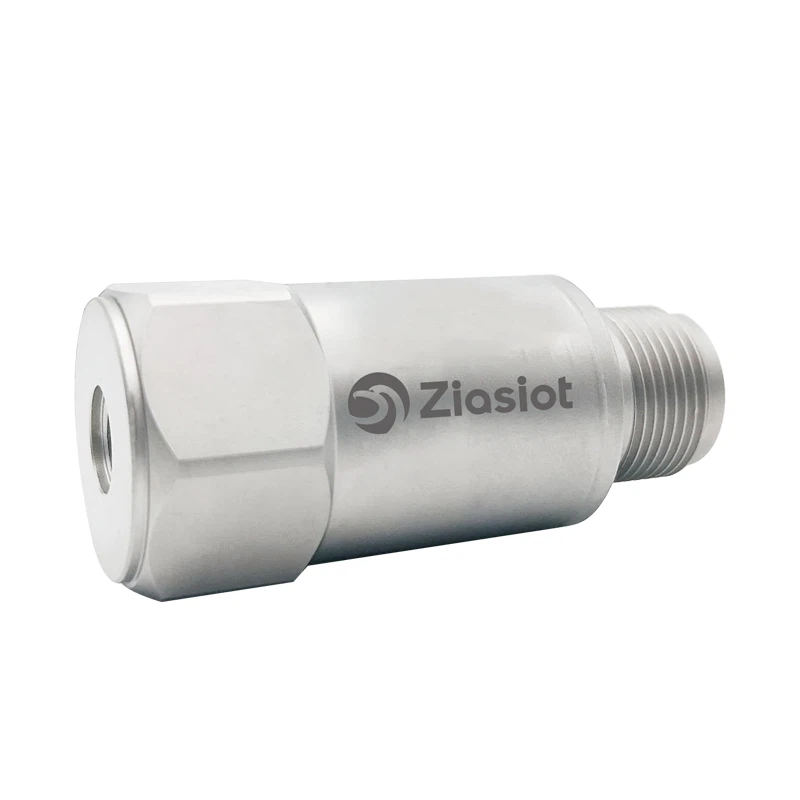
Ziasiot ZSS21D04 Vibration Sensors are stainless steel shell, laser welding sealing, shell insulation, waterproof, dust-proof, oil-proof design, suitable for various industrial sites. Built-in IEPE circuit, isolated floating, two-core low resistance voltage or 4-20mA output, strong anti-interference.

This article explores the primary vibration sensor types, their technical specifications, and selection principles.
1. The Triad of Vibration Sensor Categories
a) Accelerometers: The High-Frequency Experts
Accelerometers measure vibration acceleration (m/s²) with exceptional bandwidth, making them ideal for high-impact or rapid-frequency applications:
Frequency Range: 0.1Hz to 20kHz (suitable for engine diagnostics and shock testing)
Key Types:
Piezoelectric: Generates electrical signals via crystal deformation, with range up to 10,000g .
MEMS (Micro-Electro-Mechanical Systems): Miniaturized silicon-based designs for IoT monitoring, ranging from ±2g to 200g .
ICP (Integrated Circuit Piezoelectric): Built-in amplification for 机床 and motor diagnostics, with 0.5g to 500g ranges .
b) Velocity Sensors: Mid-Frequency Workhorses
Designed for rotating machinery, velocity sensors measure vibration speed (mm/s) across 10Hz to 2kHz:
Advantages: Stable performance in medium-frequency ranges (e.g., pump and gearbox monitoring)
Industrial Example: The Ziasiot ZSS21D04 offers ±1270 mm/s measurement with 4-20mA output for easy PLC integration .
c) Displacement Sensors: Low-Frequency Specialists
Ideal for large-scale structures or slow-moving components:
Frequency Range: 0 to 500Hz
Application: Bridge health monitoring and turbine shaft alignment checks
2. Accelerometer Subcategories: A Comparative Analysis
|
Sensor Type |
Working Principle |
Measurement Range |
Typical Industrial Use Cases |
|
Piezoelectric |
Crystal deformation generates charge |
5g to 10,000g |
Engine vibration analysis, impact testing |
|
Piezoresistive |
Strain gauge resistance change |
0 to 2000g |
Building structure monitoring |
|
MEMS |
Microfabricated silicon structures |
±2g to 200g |
Industrial IoT devices, portable monitors |
|
ICP |
Built-in charge amplifier |
0.5g to 500g |
Machine tool diagnostics, motor health checks |
3. Golden Principles for Vibration Sensor Selection
Priority 1: Frequency Range Matching
The sensor's bandwidth must exceed 2.56× the target vibration frequency.
fsensor≥2.56×ftarg
fsensor≥2.56×ftarget
Example: For a 500Hz turbine vibration, choose a sensor with ≥1.28kHz frequency response.
Priority 2: Peak Range Coverage
Ensure the sensor range covers 120% of the estimated maximum vibration acceleration.
Caution: Under-range sensors risk signal clipping and data distortion.
3. Priority 3: Environmental Adaptability
High Temperature (>150°C): Opt for charge-type piezoelectric sensors.
Electromagnetic Interference: Deploy fiber optic accelerometers for EMI immunity.
Underwater Applications: Require IP68-rated sealed enclosures, like the Ziasiot ZSS21D04 with laser-welded stainless steel housing .
4. Real-World Industrial Case Studies
Case 1: Steam Turbine Monitoring
Challenge: 300Hz vibration at 120°C in a power plant turbine.
Solution: Piezoresistive accelerometer with 50g 量程,0-1kHz frequency response, and 150°C temperature tolerance.
Outcome: 40% reduction in unplanned downtime through early bearing wear detection.
Case 2: Chemical Plant Pump System
Requirement: Continuous monitoring of a centrifugal pump's 160Hz vibrations in an oily environment.
Solution: IP65-rated piezoelectric sensor (100mV/g sensitivity) with stainless steel construction .
Result: 60% maintenance cost savings by predicting impeller imbalance before failure.
5. Common Selection Pitfalls to Avoid
Neglecting Mounting Methods:
Magnetic bases suit temporary setups, while threaded mounts (e.g., 1/4-28 threads) ensure stable data in high-vibration environments.
Overlooking Output Signals:
4-20mA current loops are ideal for long-distance transmission, while IEPE outputs simplify integration with modern data loggers.
Elevate Your Industrial Monitoring Strategy
Choosing the right vibration sensor is critical for maximizing equipment reliability. The Ziasiot ZSS21D04 industrial vibration sensor combines high sensitivity (100mV/g), wide temperature tolerance (-40°C to +120°C), and rugged IP65 protection-making it a versatile solution for diverse industrial applications.
Explore the ZSS21D04 Vibration Sensor to discover how precision vibration detection can transform your predictive maintenance program.