
What is the dynamic response of a pressure gauge?
Leave a message

What is the dynamic response of a pressure gauge?
As a leading supplier of pressure gauges, I often encounter inquiries about the dynamic response of these essential measuring instruments. Understanding the dynamic response of a pressure gauge is crucial for ensuring accurate and reliable pressure measurements in various applications, from industrial processes to laboratory experiments. In this blog post, I will delve into the concept of dynamic response, its significance, and how it relates to the performance of different types of pressure gauges we offer.
Understanding Dynamic Response
The dynamic response of a pressure gauge refers to its ability to accurately track and measure rapid changes in pressure over time. In many real-world applications, pressure is not static but varies continuously, sometimes at high frequencies. For instance, in hydraulic systems, pressure can fluctuate rapidly during the operation of pumps and valves. A pressure gauge with a poor dynamic response may not be able to capture these rapid changes accurately, leading to inaccurate measurements and potentially affecting the overall performance of the system.


The dynamic response of a pressure gauge is typically characterized by two main parameters: rise time and settling time. The rise time is the time it takes for the gauge's output to rise from a specified low value (usually 10% of the final value) to a specified high value (usually 90% of the final value) in response to a step change in pressure. A shorter rise time indicates a faster response and better ability to track rapid pressure changes.
The settling time, on the other hand, is the time it takes for the gauge's output to settle within a specified tolerance band (usually ±1% or ±2% of the final value) after a step change in pressure. A shorter settling time means that the gauge reaches a stable reading more quickly, reducing the time required for accurate measurements.
Factors Affecting Dynamic Response
Several factors can affect the dynamic response of a pressure gauge. One of the most significant factors is the type of sensing element used in the gauge. Different sensing elements have different mechanical and electrical properties, which can influence their response times.
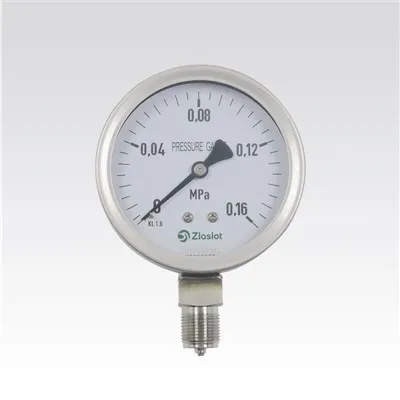
For example, mechanical pressure gauges, such as Mechanical Presssure Gauge, typically use a Bourdon tube, diaphragm, or bellows as the sensing element. These mechanical elements have relatively slow response times due to their inertia and mechanical compliance. As a result, mechanical pressure gauges are generally better suited for measuring static or slowly changing pressures.
In contrast, digital pressure gauges, such as Vacuum Digital Pressure Gauge and Digital Melt Presssure Gauges, often use electronic sensing elements, such as strain gauges or piezoelectric sensors. These electronic elements have much faster response times compared to mechanical elements, making digital pressure gauges more suitable for measuring rapidly changing pressures.
Another factor that can affect the dynamic response of a pressure gauge is the damping of the system. Damping is used to reduce the oscillations and overshoot of the gauge's output in response to a step change in pressure. However, excessive damping can also slow down the response time of the gauge. Therefore, it is important to find the right balance between damping and response time to ensure optimal performance.
The size and shape of the pressure port and the connecting tubing can also have an impact on the dynamic response of a pressure gauge. A small or restricted pressure port can cause a delay in the pressure transmission to the sensing element, resulting in a slower response time. Similarly, long or narrow connecting tubing can introduce additional damping and delay the pressure signal.
Importance of Dynamic Response in Different Applications
The importance of the dynamic response of a pressure gauge depends on the specific application. In some applications, such as monitoring the pressure in a water tank or a gas pipeline, the pressure changes relatively slowly, and a pressure gauge with a slower dynamic response may be sufficient. However, in other applications, such as measuring the pressure in an internal combustion engine or a high-speed hydraulic system, the pressure can change very rapidly, and a pressure gauge with a fast dynamic response is essential.
In the automotive industry, for example, accurate measurement of the in-cylinder pressure is crucial for optimizing engine performance and reducing emissions. A pressure gauge with a fast dynamic response can capture the rapid pressure changes during the combustion process, providing valuable information for engine tuning and control.
In the aerospace industry, pressure gauges are used to measure the pressure in various systems, such as the hydraulic system, the fuel system, and the cabin pressurization system. These systems often experience rapid pressure changes during flight maneuvers, and a pressure gauge with a fast dynamic response is necessary to ensure the safety and reliability of the aircraft.
In the manufacturing industry, pressure gauges are used in a wide range of processes, such as injection molding, extrusion, and metal forming. In these processes, accurate measurement of the pressure is critical for ensuring the quality and consistency of the products. A pressure gauge with a fast dynamic response can help detect and correct any pressure fluctuations in real-time, minimizing the risk of product defects.
Selecting the Right Pressure Gauge for Your Application
When selecting a pressure gauge for your application, it is important to consider the dynamic response requirements. If you need to measure rapidly changing pressures, a digital pressure gauge with a fast dynamic response is usually the best choice. Our Vacuum Digital Pressure Gauge and Digital Melt Presssure Gauges are designed to provide accurate and reliable measurements of rapidly changing pressures, with fast rise times and short settling times.
On the other hand, if you only need to measure static or slowly changing pressures, a mechanical pressure gauge may be sufficient. Our Mechanical Presssure Gauge offers a cost-effective solution for applications where high dynamic response is not required.
In addition to the dynamic response, you should also consider other factors, such as the pressure range, accuracy, reliability, and environmental conditions. Our team of experts can help you select the right pressure gauge for your specific application based on your requirements and budget.
Conclusion
The dynamic response of a pressure gauge is a critical factor that determines its ability to accurately measure rapid changes in pressure. Understanding the concept of dynamic response, its significance, and the factors that affect it is essential for selecting the right pressure gauge for your application.
As a leading supplier of pressure gauges, we offer a wide range of products with different dynamic response characteristics to meet the needs of various applications. Whether you need a pressure gauge for measuring static or rapidly changing pressures, we have the solution for you.
If you have any questions or need further information about the dynamic response of our pressure gauges or need help selecting the right product for your application, please do not hesitate to contact us. Our team of experts is always ready to assist you with your pressure measurement needs.
References
- Doebelin, E. O. (2003). Measurement Systems: Application and Design. McGraw-Hill.
- Holman, J. P. (2001). Experimental Methods for Engineers. McGraw-Hill.
- Kutz, M. (2006). Mechanical Engineers' Handbook. John Wiley & Sons.