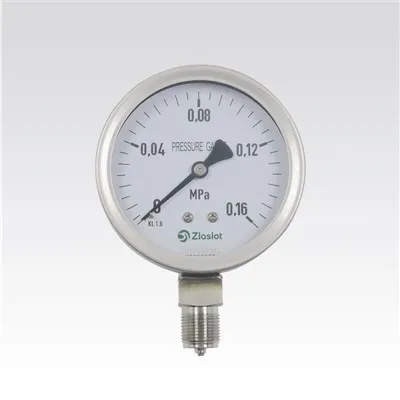

What is the difference between gauge pressure and absolute pressure in a digital pressure gauge?
Leave a message

When it comes to measuring pressure in various industrial and scientific applications, digital pressure gauges have become indispensable tools. As a leading supplier of digital pressure gauges, I often encounter questions from customers about the difference between gauge pressure and absolute pressure. In this blog post, I'll delve into these two concepts, explain their significance, and highlight how understanding them can help you make the right choice for your pressure measurement needs.
Understanding Pressure Basics
Before we dive into the differences between gauge pressure and absolute pressure, let's first understand what pressure is. Pressure is defined as the force exerted per unit area. In the context of pressure gauges, it refers to the force exerted by a fluid (liquid or gas) on the walls of a container or a surface.
Gauge Pressure
Gauge pressure is the pressure relative to the local atmospheric pressure. It measures the pressure above or below the atmospheric pressure. When you use a gauge pressure gauge, it displays the pressure difference between the measured pressure and the atmospheric pressure. For example, if the atmospheric pressure is 101.3 kPa (kilopascals) and the gauge pressure reads 50 kPa, the actual pressure is 101.3 kPa + 50 kPa = 151.3 kPa.
Gauge pressure is commonly used in many industrial applications, such as measuring the pressure in pipes, tanks, and hydraulic systems. It is also used in everyday life, for example, when checking the tire pressure of a car. The tire pressure gauge measures the pressure above the atmospheric pressure, which is why you need to add the atmospheric pressure to the gauge reading to get the actual pressure inside the tire.
One of the advantages of using gauge pressure is that it is easier to measure and interpret. Since it is relative to the atmospheric pressure, it eliminates the need to account for changes in atmospheric pressure due to altitude or weather conditions. However, it is important to note that gauge pressure readings can be affected by changes in atmospheric pressure, especially in applications where high accuracy is required.
Absolute Pressure
Absolute pressure, on the other hand, is the total pressure, including the atmospheric pressure. It measures the pressure relative to a perfect vacuum. An absolute pressure gauge reads zero when there is a perfect vacuum and increases as the pressure increases. For example, if the atmospheric pressure is 101.3 kPa and the absolute pressure reads 150 kPa, the pressure above the atmospheric pressure is 150 kPa - 101.3 kPa = 48.7 kPa.
Absolute pressure is commonly used in applications where the pressure needs to be measured relative to a perfect vacuum, such as in vacuum systems, high-altitude applications, and scientific research. It is also used in some industrial processes where the absolute pressure is critical for the operation of the equipment.
One of the advantages of using absolute pressure is that it provides a more accurate measurement of the pressure, especially in applications where the atmospheric pressure can vary significantly. However, it is more difficult to measure and interpret than gauge pressure, as it requires a reference to a perfect vacuum.


Key Differences between Gauge Pressure and Absolute Pressure
Now that we have a basic understanding of gauge pressure and absolute pressure, let's summarize the key differences between the two:
- Reference Point: Gauge pressure is measured relative to the local atmospheric pressure, while absolute pressure is measured relative to a perfect vacuum.
- Zero Reading: A gauge pressure gauge reads zero when the pressure is equal to the atmospheric pressure, while an absolute pressure gauge reads zero when there is a perfect vacuum.
- Measurement Range: Gauge pressure can be positive or negative, depending on whether the pressure is above or below the atmospheric pressure. Absolute pressure is always positive, as it represents the total pressure.
- Applications: Gauge pressure is commonly used in industrial applications where the pressure is measured relative to the atmospheric pressure, while absolute pressure is used in applications where the pressure needs to be measured relative to a perfect vacuum.
Choosing the Right Pressure Gauge
When choosing a pressure gauge, it is important to consider the type of pressure you need to measure (gauge or absolute) and the specific requirements of your application. Here are some factors to consider:
- Application Requirements: Determine whether you need to measure gauge pressure or absolute pressure based on the nature of your application. If you are measuring the pressure in a system that is open to the atmosphere, gauge pressure may be sufficient. However, if you are working with vacuum systems or applications where the absolute pressure is critical, an absolute pressure gauge is required.
- Accuracy: Consider the accuracy requirements of your application. Absolute pressure gauges generally provide more accurate measurements, especially in applications where the atmospheric pressure can vary significantly. However, they are also more expensive and may require more complex calibration procedures.
- Measurement Range: Choose a pressure gauge with a measurement range that is suitable for your application. Make sure the gauge can measure the maximum and minimum pressures that you expect to encounter.
- Environmental Conditions: Consider the environmental conditions in which the pressure gauge will be used. Some pressure gauges are designed to withstand high temperatures, corrosive environments, or other harsh conditions.
Our Digital Pressure Gauges
As a supplier of digital pressure gauges, we offer a wide range of products to meet the diverse needs of our customers. Our digital pressure gauges are available in both gauge and absolute pressure versions, and they are designed to provide accurate and reliable pressure measurements in various applications.
- High Temperature Mechanical Melt Presssure Gauges: Our high temperature mechanical melt pressure gauges are designed to measure the pressure of molten materials in high-temperature applications. They are suitable for use in plastics processing, rubber manufacturing, and other industries.
- Vacuum Digital Pressure Gauge: Our vacuum digital pressure gauges are designed to measure the pressure in vacuum systems. They are available in both gauge and absolute pressure versions, and they provide accurate and reliable measurements in a wide range of vacuum applications.
- Digital Melt Presssure Gauges: Our digital melt pressure gauges are designed to measure the pressure of molten materials in injection molding, extrusion, and other plastic processing applications. They are available in both gauge and absolute pressure versions, and they provide accurate and reliable measurements in a wide range of temperatures and pressures.
Contact Us for Your Pressure Measurement Needs
If you have any questions about gauge pressure, absolute pressure, or our digital pressure gauges, please don't hesitate to contact us. Our team of experts is available to help you choose the right pressure gauge for your application and provide you with the support and service you need. Whether you are a small business or a large industrial corporation, we are committed to providing you with high-quality products and exceptional customer service.
References
- Holman, J. P. (2001). Thermodynamics. McGraw-Hill.
- Van Wylen, G. J., & Sonntag, R. E. (1994). Fundamentals of Classical Thermodynamics. Wiley.