
Can Turbine Flow Meters measure gas flow?
Leave a message

Can Turbine Flow Meters measure gas flow?
As a supplier of Turbine Flow Meters, I often encounter questions from customers regarding the capabilities of our products. One of the most frequently asked questions is whether turbine flow meters can measure gas flow. In this blog post, I will delve into this topic, exploring the principles of turbine flow meters, their suitability for gas flow measurement, and the factors that influence their performance.
How Turbine Flow Meters Work
Turbine flow meters operate on the principle of fluid - driven rotation. When a fluid (either liquid or gas) passes through the flow meter, it strikes the turbine blades, causing them to rotate. The rotational speed of the turbine is directly proportional to the flow rate of the fluid. A sensor, typically a magnetic pickup, detects the rotation of the turbine and converts it into an electrical signal. This signal is then processed to determine the flow rate and, often, the total volume of fluid that has passed through the meter.


The basic equation that governs the operation of a turbine flow meter is (Q = kN), where (Q) is the flow rate, (N) is the rotational speed of the turbine, and (k) is a calibration constant specific to the meter. This relationship holds true as long as the flow is stable, and the fluid properties remain relatively constant.
Measuring Gas Flow with Turbine Flow Meters
The short answer is yes, turbine flow meters can measure gas flow. However, there are several factors that need to be considered when using them for this purpose.
Advantages of Using Turbine Flow Meters for Gas Flow
- High Accuracy: Turbine flow meters can provide relatively high - accuracy measurements for gas flow, especially in applications where the flow is stable and the gas properties are well - defined. They can achieve accuracies within ±0.5% to ±1% of the reading under optimal conditions.
- Wide Turndown Ratio: These meters typically have a wide turndown ratio, which means they can accurately measure gas flow over a broad range of flow rates. A good turbine flow meter can handle flow rates from a few cubic meters per hour to several thousand cubic meters per hour.
- Fast Response Time: Turbine flow meters have a fast response time, making them suitable for applications where rapid changes in gas flow need to be monitored. This is particularly important in processes such as gas distribution systems, where real - time flow information is crucial for efficient operation.
Challenges in Measuring Gas Flow
- Gas Density and Viscosity: Gas density and viscosity play a significant role in the performance of turbine flow meters. Unlike liquids, the density and viscosity of gases can vary significantly with changes in temperature, pressure, and composition. These variations can affect the calibration of the meter and lead to measurement errors. For example, a decrease in gas density can cause the turbine to rotate more slowly than expected for a given flow rate, resulting in an under - estimation of the flow.
- Flow Profile and Turbulence: Gas flow is often more turbulent than liquid flow, and the flow profile can be less uniform. Turbulence can cause the turbine to experience uneven forces, leading to inaccurate readings. To mitigate this issue, proper installation techniques, such as the use of straightening vanes upstream of the meter, are often required to ensure a more laminar flow.
- Wear and Tear: The moving parts of a turbine flow meter, such as the turbine blades, are subject to wear and tear when measuring gas flow. The high - velocity gas can cause erosion of the blades over time, which can affect the accuracy and reliability of the meter. Regular maintenance and calibration are necessary to ensure long - term performance.
Factors Influencing the Performance of Turbine Flow Meters in Gas Flow Measurement
Temperature and Pressure
Temperature and pressure have a direct impact on the density and viscosity of the gas. As mentioned earlier, changes in these properties can affect the calibration of the turbine flow meter. To account for these effects, many modern turbine flow meters are equipped with temperature and pressure sensors. These sensors measure the actual temperature and pressure of the gas and use this information to correct the flow measurement based on the ideal gas law or more complex gas equations.
Gas Composition
The composition of the gas can also affect the performance of the turbine flow meter. Different gases have different physical properties, such as density and viscosity. For example, natural gas is a mixture of hydrocarbons, and its composition can vary depending on the source. If the gas composition changes significantly, the calibration of the meter may need to be adjusted to ensure accurate measurements.
Installation
Proper installation of the turbine flow meter is crucial for accurate gas flow measurement. The meter should be installed in a straight section of the pipeline, away from any sources of turbulence, such as valves, elbows, or tees. The recommended upstream and downstream straight - run lengths vary depending on the meter size and the specific application but are typically in the range of 10 - 20 pipe diameters upstream and 5 - 10 pipe diameters downstream.
Comparison with Other Flow Meter Types
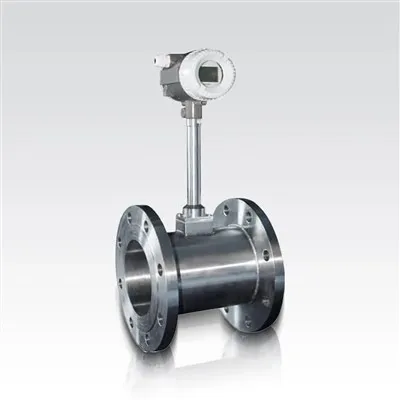
When considering gas flow measurement, it's also important to compare turbine flow meters with other types of flow meters, such as Vortex Flowmeter and LDG Electromagnetic Flowmeter.
- Vortex Flowmeters: Vortex flowmeters operate on the principle of the von Kármán vortex street. They are suitable for measuring gas flow and are known for their simplicity, reliability, and relatively low cost. However, they may have a lower accuracy compared to turbine flow meters, especially at low flow rates.
- LDG Electromagnetic Flowmeters: These flow meters are based on Faraday's law of electromagnetic induction and are mainly used for measuring the flow of conductive liquids. They are not suitable for gas flow measurement because gases are non - conductive.
Conclusion and Call to Action
In conclusion, turbine flow meters can be a viable option for measuring gas flow, provided that the challenges associated with gas properties, flow conditions, and installation are properly addressed. Their high accuracy, wide turndown ratio, and fast response time make them suitable for a variety of gas flow applications, including natural gas distribution, industrial gas processing, and combustion control.
If you are in need of a reliable flow measurement solution for your gas flow application, our Turbine Flow Meter products are designed to meet your needs. Our team of experts can provide you with detailed technical support and guidance to ensure that you select the right meter for your specific requirements. We encourage you to reach out to us for further discussion and to explore the possibilities of incorporating our turbine flow meters into your processes. Whether you are looking for a new installation or need to upgrade an existing system, we are here to help you achieve accurate and reliable gas flow measurement.
References
- Miller, R. W. (1983). Flow measurement engineering handbook. McGraw - Hill.
- Spitzer, D. W. (2001). Flow measurement: Practical guides for measurement and control. ISA - The Instrumentation, Systems, and Automation Society.
- ISO 5167 - 1:2003, Measurement of fluid flow by means of pressure differential devices inserted in circular cross - section conduits running full - Part 1: General principles and requirements.