
What is the difference between a local and remote - reading homogenizer pressure gauge?
Leave a message

When it comes to homogenizers, the pressure gauge is a critical component that ensures the proper functioning of the equipment. As a trusted Homogenizer Pressure Gauge supplier, we often encounter questions from customers about the differences between local and remote-reading homogenizer pressure gauges. In this blog post, we will delve into the details of these two types of gauges, highlighting their features, advantages, and applications.
Local Reading Homogenizer Pressure Gauges
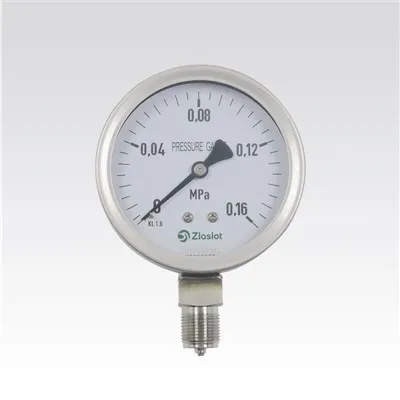
Local reading homogenizer pressure gauges are the traditional type of gauges that are directly installed on the homogenizer. They provide a real-time visual indication of the pressure within the homogenizer system. These gauges are typically mechanical or digital and are designed to be mounted in a convenient location for easy viewing by the operator.
Features and Advantages
- Direct Visual Monitoring: One of the primary advantages of local reading gauges is the ability to directly monitor the pressure. The operator can quickly glance at the gauge and get an immediate reading of the pressure, which is crucial for maintaining the optimal operating conditions of the homogenizer.
- Simple Installation: Local reading gauges are relatively easy to install. They can be directly mounted on the homogenizer using standard fittings, and no additional wiring or communication systems are required.
- Cost-Effective: Compared to remote-reading gauges, local reading gauges are generally more cost-effective. They do not require additional components such as transmitters or receivers, which can significantly reduce the overall cost of the system.
- Reliability: Mechanical local reading gauges are known for their reliability. They have fewer components and are less prone to electronic failures, making them a popular choice for many applications.
Applications
Local reading gauges are commonly used in small to medium-sized homogenizers where the operator can easily access the gauge for monitoring. They are suitable for applications where real-time pressure monitoring is required, such as in food and beverage processing, pharmaceutical manufacturing, and cosmetic production.
Remote Reading Homogenizer Pressure Gauges
Remote reading homogenizer pressure gauges, on the other hand, allow the operator to monitor the pressure from a distance. These gauges use a transmitter to send the pressure data to a receiver, which can be located in a control room or other remote location.
Features and Advantages
- Remote Monitoring: The main advantage of remote reading gauges is the ability to monitor the pressure from a distance. This is particularly useful in large-scale homogenizer systems where the operator may not be able to access the gauge directly. Remote monitoring also allows for real-time data collection and analysis, which can help in optimizing the homogenization process.
- Data Logging and Analysis: Remote reading gauges often come with data logging capabilities, which allow the operator to record and analyze the pressure data over time. This can be useful for troubleshooting, quality control, and process optimization.
- Multiple Gauge Monitoring: With remote reading gauges, it is possible to monitor multiple gauges from a single location. This can be beneficial in large-scale homogenizer systems where multiple gauges are used to monitor different parts of the system.
- Integration with Control Systems: Remote reading gauges can be easily integrated with other control systems, such as programmable logic controllers (PLCs) and supervisory control and data acquisition (SCADA) systems. This allows for automated control of the homogenizer based on the pressure readings.
Applications
Remote reading gauges are commonly used in large-scale homogenizer systems, such as those used in industrial manufacturing and chemical processing. They are also suitable for applications where the operator needs to monitor the pressure from a safe distance, such as in hazardous environments.
Key Differences
Now that we have discussed the features and advantages of local and remote reading homogenizer pressure gauges, let's summarize the key differences between the two:
- Monitoring Location: Local reading gauges are installed directly on the homogenizer and provide a direct visual indication of the pressure. Remote reading gauges, on the other hand, allow the operator to monitor the pressure from a distance.
- Installation Complexity: Local reading gauges are relatively easy to install and do not require additional wiring or communication systems. Remote reading gauges, however, require the installation of a transmitter and a receiver, which can be more complex and costly.
- Data Logging and Analysis: Remote reading gauges often come with data logging capabilities, which allow for real-time data collection and analysis. Local reading gauges typically do not have this feature.
- Cost: Local reading gauges are generally more cost-effective than remote reading gauges, as they do not require additional components such as transmitters and receivers.
Choosing the Right Gauge
When choosing between a local and remote reading homogenizer pressure gauge, several factors need to be considered, including the size of the homogenizer system, the location of the operator, the need for data logging and analysis, and the budget.
If you have a small to medium-sized homogenizer system and the operator can easily access the gauge for monitoring, a local reading gauge may be the best choice. It is simple to install, cost-effective, and provides a direct visual indication of the pressure.


On the other hand, if you have a large-scale homogenizer system or need to monitor the pressure from a distance, a remote reading gauge may be more suitable. It allows for remote monitoring, data logging, and integration with other control systems, which can help in optimizing the homogenization process.
As a Homogenizer Pressure Gauge supplier, we offer a wide range of Mechanical Presssure Gauge, Vacuum Digital Pressure Gauge, and Digital Melt Presssure Gauges to meet your specific needs. Our gauges are designed to provide accurate and reliable pressure measurements, ensuring the optimal performance of your homogenizer.
If you are interested in learning more about our products or have any questions about choosing the right gauge for your application, please feel free to contact us. We are here to help you make the best decision for your homogenizer system.
References
- "Pressure Gauges: A Comprehensive Guide." InstrumentationTools.com.
- "Homogenizer Technology and Applications." Food and Beverage Processing Magazine.
- "Remote Monitoring and Control Systems for Industrial Processes." Control Engineering Magazine.