What is the working principle of a melt pressure indicator?
Leave a message

The melt pressure indicator is a crucial device in various industrial processes, especially in those involving the handling of molten materials. As a supplier of melt pressure indicators, I am often asked about how these devices work. In this blog post, I will delve into the working principle of a melt pressure indicator, exploring its components, how it measures pressure, and its significance in industrial applications.
Components of a Melt Pressure Indicator
A melt pressure indicator typically consists of several key components, each playing a vital role in its operation. The main parts include a pressure sensor, a signal processing unit, and a display.
Pressure Sensor
The pressure sensor is the heart of the melt pressure indicator. It is designed to detect the pressure of the molten material and convert it into an electrical signal. There are different types of pressure sensors used in melt pressure indicators, but the most common ones are strain - gauge sensors.
Strain - gauge sensors work based on the principle of the change in electrical resistance when a material is subjected to mechanical strain. In a melt pressure indicator, the sensor is often in contact with the molten material through a diaphragm. When the pressure of the molten material acts on the diaphragm, it deforms slightly. This deformation is transferred to the strain gauges attached to the diaphragm. The strain gauges are made of a material whose electrical resistance changes proportionally to the applied strain. As the diaphragm deforms, the resistance of the strain gauges changes, and this change in resistance can be measured as an electrical signal.
Signal Processing Unit
The electrical signal produced by the pressure sensor is usually very small and needs to be amplified and processed before it can be used. The signal processing unit takes the raw signal from the pressure sensor and amplifies it to a usable level. It also performs other functions such as filtering out noise and interference from the signal.
Filtering is an important process because in an industrial environment, there can be a lot of electrical noise from various sources such as motors, inverters, and other electrical equipment. The signal processing unit uses filters to remove this noise, ensuring that the signal representing the actual pressure is clear and accurate.
Display
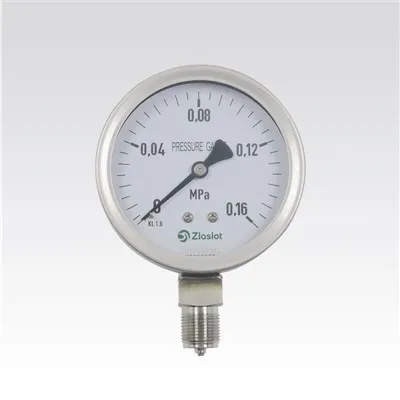
The display is the part of the melt pressure indicator that shows the measured pressure to the user. It can be a simple analog display, which uses a needle to indicate the pressure on a scale, or a digital display, which shows the pressure value in numerical form. Digital displays are becoming more popular because they are easier to read and more accurate. They can also provide additional information such as minimum and maximum pressure values, pressure trends over time, and alarms when the pressure exceeds a certain limit.
How a Melt Pressure Indicator Measures Pressure
The process of measuring pressure with a melt pressure indicator can be divided into several steps.
First, the pressure sensor comes into contact with the molten material. The diaphragm of the pressure sensor is designed to be resistant to the high temperatures and corrosive nature of the molten material. As the molten material exerts pressure on the diaphragm, it causes a deformation.
The strain gauges attached to the diaphragm detect this deformation and convert it into a change in electrical resistance. The change in resistance is then translated into a change in electrical voltage by a bridge circuit, which is a common circuit configuration used in strain - gauge - based pressure sensors.
The electrical voltage signal is then sent to the signal processing unit. The signal processing unit amplifies the signal, filters out any noise, and may also perform linearization to ensure that the relationship between the input pressure and the output signal is linear.
Finally, the processed signal is sent to the display, where the measured pressure value is shown to the user. In some advanced melt pressure indicators, the signal can also be sent to a control system, which can use the pressure information to adjust the process parameters.
Significance in Industrial Applications
Melt pressure indicators play a crucial role in many industrial applications, especially in the plastics, rubber, and food industries.
Plastics Industry
In the plastics industry, melt pressure indicators are used in extrusion and injection molding processes. In extrusion, the pressure of the molten plastic needs to be carefully controlled to ensure a consistent flow rate and product quality. If the pressure is too high, it can cause the plastic to burst out of the die or damage the equipment. If the pressure is too low, the plastic may not fill the mold properly, resulting in defective products.
In injection molding, the melt pressure is critical during the filling and packing phases. The pressure indicator helps the operator to monitor the pressure and adjust the injection speed and pressure accordingly to ensure that the mold is filled completely and the product has the desired properties.
Rubber Industry
In the rubber industry, melt pressure indicators are used in processes such as rubber extrusion and molding. Rubber is a viscoelastic material, and its flow behavior is highly dependent on pressure. By monitoring the melt pressure, manufacturers can ensure that the rubber is processed at the right pressure, which is essential for achieving the desired product quality, such as the correct hardness, elasticity, and shape.


Food Industry
In the food industry, melt pressure indicators are used in processes such as chocolate molding, extrusion of pasta, and production of confectionery. In chocolate molding, for example, the pressure of the molten chocolate needs to be controlled to ensure that it fills the molds evenly and forms a smooth surface. In pasta extrusion, the pressure affects the texture and shape of the pasta.
Our Product Offerings
As a supplier of melt pressure indicators, we offer a wide range of products to meet the diverse needs of our customers. Our Pressure Indicator is designed to provide accurate and reliable pressure measurement in various industrial applications. It features a high - precision pressure sensor and a user - friendly digital display.
We also offer Homogenizer Digital Pressure Gauge, which is specifically designed for use in homogenization processes. It can withstand high pressures and provides accurate pressure readings in real - time.
In addition, our Melt Pressure Controller not only measures the pressure but also allows for precise control of the pressure. It uses advanced control algorithms to maintain the pressure at the desired setpoint, ensuring consistent product quality.
Contact Us for Procurement
If you are in need of a high - quality melt pressure indicator for your industrial process, we are here to help. Our team of experts can provide you with detailed information about our products, assist you in selecting the right product for your specific requirements, and offer after - sales support.
To start the procurement process, simply reach out to us and let us know about your needs. We look forward to working with you and helping you improve your industrial processes through accurate pressure measurement.
References
- "Pressure Measurement Handbook"
- "Industrial Sensors and Their Applications"
- Technical documents from leading melt pressure indicator manufacturers.