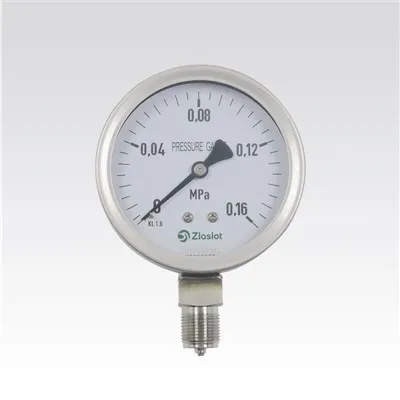

What is the minimum pressure a digital pressure gauge can measure?
Leave a message

Hey there! As a supplier of digital pressure gauges, I often get asked about the minimum pressure these nifty devices can measure. It's a great question, and today, I'm gonna break it down for you.
First off, let's understand what a digital pressure gauge is. It's a modern instrument used to measure pressure, and it gives you a digital readout, which is super convenient. Unlike the old - school mechanical gauges, digital ones are more accurate, easier to read, and often come with additional features like data logging and connectivity options.
Now, the minimum pressure a digital pressure gauge can measure depends on a few factors. One of the main factors is the type of sensor used in the gauge. There are different types of sensors, such as piezoresistive, capacitive, and piezoelectric sensors. Each type has its own characteristics and capabilities when it comes to measuring pressure.


Piezoresistive sensors are quite common. They work by changing their electrical resistance when pressure is applied. These sensors can typically measure pressures starting from a few millibars. For example, some of our basic piezoresistive - based digital pressure gauges can measure pressures as low as 1 mbar. That's a really small amount of pressure! It's like feeling the gentle breeze of a feather floating through the air.
Capacitive sensors, on the other hand, measure pressure by detecting changes in capacitance. They are known for their high sensitivity and can sometimes measure even lower pressures. Some high - end capacitive - based digital pressure gauges in our catalog can measure pressures down to 0.1 mbar. This level of sensitivity makes them ideal for applications where extremely low pressures need to be monitored, like in some scientific research or semiconductor manufacturing processes.
Piezoelectric sensors generate an electric charge when pressure is applied. They are often used in high - frequency and dynamic pressure measurement applications. While they are not typically known for measuring the absolute lowest pressures compared to piezoresistive and capacitive sensors, some of our specialized piezoelectric digital pressure gauges can still measure pressures starting from a few tens of millibars.
Another factor that affects the minimum measurable pressure is the design and calibration of the gauge itself. A well - designed gauge with proper calibration can achieve better performance at low pressures. At our company, we take great care in the design and calibration of our digital pressure gauges. We use state - of - the - art manufacturing processes and calibration equipment to ensure that our gauges are as accurate as possible, even at the lowest pressure ranges.
Let's talk about some real - world applications where measuring low pressures is crucial. In the field of vacuum technology, for instance, precise measurement of low pressures is essential. Vacuum systems are used in a wide range of industries, from food packaging to aerospace. A Vacuum Digital Pressure Gauge can help monitor these low pressures accurately, ensuring that the vacuum process is working as intended.
In the plastics industry, when dealing with melt pressure, digital pressure gauges are also very important. Digital Melt Presssure Gauges need to be able to measure the pressure of the molten plastic accurately. Sometimes, the pressure at the start of the melting process can be relatively low, and a gauge with a low minimum measurable pressure can provide valuable insights into the process.
High - temperature applications also require special consideration. High Temperature Mechanical Melt Presssure Gauges are designed to withstand extreme temperatures while still accurately measuring pressure. Even in these harsh environments, the minimum pressure measurement capability is important to ensure the proper operation of the equipment.
When it comes to choosing a digital pressure gauge with the right minimum pressure measurement capability, you need to consider your specific application. If you're working on a project that requires measuring very low pressures, like in a laboratory setting for gas flow experiments, you'll want a gauge with a very low minimum measurable pressure. On the other hand, if you're just monitoring the pressure in a general industrial process where the pressure is usually higher, a gauge with a slightly higher minimum measurement range might be sufficient.
It's also important to note that the accuracy of the gauge at low pressures can vary. Some gauges might have a higher percentage of error at the lower end of their measurement range. At our company, we provide detailed specifications for each of our gauges, including the accuracy at different pressure ranges. This way, you can make an informed decision based on your requirements.
In addition to the minimum pressure measurement, you should also consider other features of the digital pressure gauge. For example, does it have a backlit display for easy reading in low - light conditions? Can it be connected to a computer or other devices for data collection and analysis? These additional features can add a lot of value to the gauge and make your work easier.
If you're in the market for a digital pressure gauge and have questions about the minimum pressure it can measure or any other aspect, don't hesitate to reach out. We're here to help you find the perfect gauge for your needs. Whether you're a small business owner, a researcher, or an engineer working on a large - scale project, we have a wide range of digital pressure gauges to choose from.
So, if you think our digital pressure gauges could be a good fit for your application, let's start a conversation. We can discuss your specific requirements, provide you with more detailed information about our products, and even offer you a quote. Contact us today to get started on finding the right digital pressure gauge for your needs.
References:
- Pressure Measurement Handbook, 2nd Edition
- Fundamentals of Sensor Technology, 3rd Edition
- Industrial Pressure Measurement: Principles and Applications