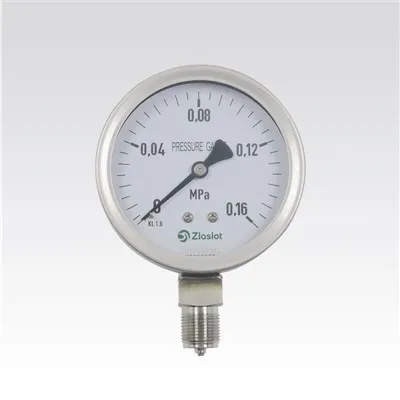

What is the difference between a pressure gauge and a manometer?
Leave a message

What is the difference between a pressure gauge and a manometer?
In the realm of pressure measurement, two commonly used instruments are pressure gauges and manometers. As a supplier of pressure gauges, I often encounter inquiries about the differences between these two devices. In this blog post, I will delve into the distinctions between pressure gauges and manometers, exploring their working principles, applications, advantages, and limitations.
Working Principles
Pressure Gauges
Pressure gauges are devices designed to measure the pressure of a fluid (liquid or gas) relative to a reference pressure. There are various types of pressure gauges, including mechanical and digital ones.
Mechanical pressure gauges, such as the Bourdon tube gauge, are widely used. The Bourdon tube is a curved, hollow tube that straightens when pressure is applied to its interior. This movement is then transferred through a mechanical linkage to a pointer on a calibrated scale, indicating the pressure. Another type is the diaphragm pressure gauge, which uses a flexible diaphragm that deflects under pressure. The deflection is measured and converted into a pressure reading. You can find more information about our Mechanical Presssure Gauge on our website.
Digital pressure gauges, on the other hand, use electronic sensors to measure pressure. These sensors convert the pressure into an electrical signal, which is then processed and displayed on a digital screen. Digital gauges offer high accuracy, fast response times, and the ability to store and transmit data. Our Digital Melt Presssure Gauges are a prime example of advanced digital pressure measurement technology.
Manometers
Manometers are based on the principle of hydrostatic equilibrium. They measure pressure by comparing the height of a liquid column in a tube to a reference pressure. The most common type is the U - tube manometer, which consists of a U - shaped tube filled with a liquid (usually mercury or water). When pressure is applied to one end of the tube, the liquid level in that side of the tube rises, while the level in the other side falls. The difference in the liquid levels is proportional to the pressure difference between the two ends of the tube.
Inclined manometers are another type, which are used to measure small pressure differences. By inclining the tube, a small pressure change results in a larger movement of the liquid along the tube, making it easier to measure accurately.
Applications
Pressure Gauges
Pressure gauges are used in a wide range of industries and applications. In the automotive industry, they are used to measure tire pressure, oil pressure, and fuel pressure. In the manufacturing sector, pressure gauges are essential for monitoring and controlling the pressure in hydraulic systems, pneumatic systems, and process pipelines. For example, in a chemical plant, pressure gauges are used to ensure that the pressure in reaction vessels and pipelines is within safe operating limits.
Our High Temperature Mechanical Melt Presssure Gauges are specifically designed for applications where high temperatures are involved, such as in the plastics and rubber industries, where they are used to measure the pressure of molten materials.
Manometers
Manometers are commonly used in applications where relatively low pressure differences need to be measured accurately. In HVAC (Heating, Ventilation, and Air Conditioning) systems, manometers are used to measure the pressure drop across air filters, ducts, and fans. This helps in ensuring proper airflow and system efficiency.
In laboratory settings, manometers are used for scientific research and experiments. They are ideal for measuring small pressure changes in gas flow systems, vacuum systems, and fluid dynamics studies.
Advantages
Pressure Gauges
One of the main advantages of pressure gauges is their wide range of measurement capabilities. They can measure pressures from very low to extremely high values, depending on the type and design of the gauge. Pressure gauges are also relatively easy to install and maintain. They can be directly mounted on pipelines or equipment, and with proper calibration, they can provide reliable and accurate pressure readings over a long period of time.
Digital pressure gauges offer additional advantages, such as the ability to provide precise readings, store data for analysis, and interface with other electronic systems. This makes them suitable for automated control systems and remote monitoring applications.


Manometers
Manometers are known for their high accuracy, especially when measuring small pressure differences. They do not require external power sources, which makes them reliable in situations where power may not be available or where electrical interference is a concern. Manometers are also relatively simple in design, which means they are less likely to malfunction compared to more complex electronic devices.
Limitations
Pressure Gauges
Some pressure gauges, especially mechanical ones, may be affected by vibration, shock, and temperature changes. These factors can cause the gauge to give inaccurate readings or even damage the internal components. Additionally, pressure gauges may require regular calibration to maintain their accuracy, which can be time - consuming and costly.
Digital pressure gauges, while offering many advantages, are more expensive than mechanical gauges. They also rely on electronic components, which can be sensitive to electromagnetic interference and may require proper shielding and grounding.
Manometers
One of the main limitations of manometers is their limited range of measurement. They are typically used for measuring relatively low pressures and pressure differences. Manometers also require the use of a liquid, which can be a problem in applications where the liquid may contaminate the system or where the environment is not suitable for using a liquid - filled device.
The liquid in a manometer can also be affected by temperature changes, which can cause the density of the liquid to change and thus affect the accuracy of the measurement.
Conclusion
In summary, pressure gauges and manometers are both important tools for pressure measurement, but they have distinct differences in terms of working principles, applications, advantages, and limitations. Pressure gauges are more versatile in terms of pressure range and are suitable for a wide variety of industrial applications. Manometers, on the other hand, are ideal for measuring small pressure differences with high accuracy, especially in HVAC systems and laboratory settings.
As a pressure gauge supplier, we offer a comprehensive range of pressure gauges to meet the diverse needs of our customers. Whether you need a mechanical pressure gauge for a simple industrial application or a high - tech digital pressure gauge for a complex control system, we have the right solution for you.
If you are interested in learning more about our pressure gauges or have specific requirements for your pressure measurement needs, please feel free to contact us for a detailed discussion and to explore the best options for your application. We are committed to providing high - quality products and excellent customer service to help you achieve accurate and reliable pressure measurement.
References
- "Pressure Measurement Handbook" by Peter Schubert
- "Instrumentation and Control Systems" by Tony B. Davis
- "Fluid Mechanics" by Frank M. White