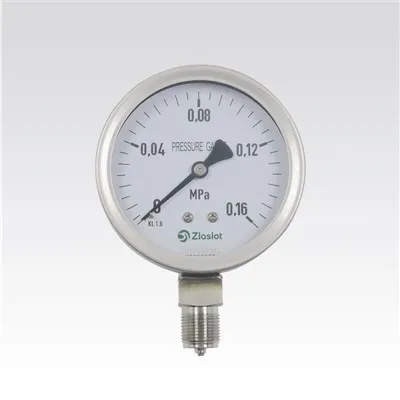
What are the signs of a faulty pressure gauge?
Leave a message

Hey there! As a supplier of Pressure Gauges, I've seen my fair share of faulty gauges over the years. In this blog post, I'm gonna share with you some signs that your pressure gauge might be on the fritz.
1. Inconsistent Readings
One of the most obvious signs of a faulty pressure gauge is inconsistent readings. You might notice that the gauge needle jumps around erratically, or that it gives different readings for the same pressure. This could be due to a number of issues, such as a damaged movement, a loose connection, or a problem with the sensing element.
For example, if you're using a High Temperature Mechanical Melt Presssure Gauges in a high-temperature environment, the heat could cause the internal components to expand and contract, leading to inconsistent readings. In this case, you might need to replace the gauge with one that's designed for high-temperature applications.
2. Slow or No Response
Another sign of a faulty pressure gauge is a slow or no response to changes in pressure. If you increase or decrease the pressure in the system and the gauge needle takes a long time to move, or doesn't move at all, there's likely a problem. This could be caused by a clogged or blocked sensing element, a damaged diaphragm, or a malfunctioning bourdon tube.
Let's say you're using a Digital Melt Presssure Gauges to measure the pressure in a melting process. If the gauge doesn't respond quickly to changes in pressure, it could lead to inaccurate readings and potentially dangerous situations. In this case, you should check the connections and the sensing element for any blockages or damage.
3. Visible Damage
Sometimes, the signs of a faulty pressure gauge are right in front of your eyes. Look for any visible damage to the gauge, such as cracks in the glass, dents in the case, or bent needles. Physical damage can affect the accuracy and functionality of the gauge, and it's usually a good idea to replace it if you notice any signs of wear and tear.
For instance, if you're using a Vacuum Digital Pressure Gauge in a rough industrial environment, it's possible that the gauge could get bumped or knocked around. If you see any visible damage, it's best to replace the gauge to ensure accurate readings.
4. Out-of-Calibration Readings
Pressure gauges need to be calibrated regularly to ensure accurate readings. If you notice that the gauge is consistently reading higher or lower than the actual pressure, it could be out of calibration. This could be due to normal wear and tear, changes in environmental conditions, or improper handling.
To check if your gauge is out of calibration, you can use a calibrated reference gauge or send it to a professional calibration service. If the gauge is out of calibration, it can usually be adjusted or recalibrated to bring it back into accuracy.
5. Leaking or Seeping
If you notice any signs of leaking or seeping around the pressure gauge, it's a serious issue. Leaking can be caused by a damaged seal, a cracked case, or a loose connection. Not only can leaking affect the accuracy of the gauge, but it can also pose a safety hazard, especially if the fluid or gas being measured is toxic or flammable.
In this situation, you should immediately shut down the system and replace the faulty gauge. Make sure to follow all safety procedures when handling and replacing the gauge to avoid any accidents.
6. Unusual Noise or Vibration
Sometimes, a faulty pressure gauge can make unusual noises or vibrations. This could be a sign of a loose internal component, a damaged movement, or a problem with the mounting. If you hear any rattling, buzzing, or humming sounds coming from the gauge, it's important to investigate the issue further.
For example, if you're using a pressure gauge in a high-vibration environment, such as a pump or compressor, the vibrations could cause the internal components to loosen or become damaged. In this case, you might need to install vibration dampeners or relocate the gauge to a more stable location.
7. Erratic Needle Movement
An erratic needle movement can also indicate a problem with the pressure gauge. The needle might flicker, oscillate, or move in an unpredictable manner. This could be due to electrical interference, a malfunctioning electronic circuit, or a problem with the mechanical linkage.


If you're using a digital pressure gauge, erratic needle movement could be a sign of a software glitch or a problem with the display. In this case, you might need to reset the gauge or contact the manufacturer for technical support.
Why It Matters
Having a faulty pressure gauge can have serious consequences. In industrial applications, inaccurate pressure readings can lead to equipment damage, production delays, and even safety hazards. For example, if a pressure gauge in a boiler system fails to accurately measure the pressure, it could result in a boiler explosion.
In addition, using a faulty pressure gauge can also lead to increased costs. You might end up wasting resources by over or under-pressurizing a system, or you could incur additional maintenance and repair costs if the gauge causes damage to other components.
What to Do If You Suspect a Faulty Gauge
If you suspect that your pressure gauge is faulty, the first thing you should do is stop using it and isolate the system. Then, visually inspect the gauge for any signs of damage or wear. If you're not sure what the problem is, it's a good idea to consult with a professional technician or the manufacturer of the gauge.
In some cases, you might be able to repair the gauge yourself if you have the necessary skills and tools. However, for more complex issues, it's usually best to have the gauge replaced or sent to a professional calibration and repair service.
Contact Us for Quality Pressure Gauges
If you're in the market for new pressure gauges or need help with troubleshooting a faulty gauge, we're here to assist you. As a leading supplier of pressure gauges, we offer a wide range of high-quality products, including High Temperature Mechanical Melt Presssure Gauges, Digital Melt Presssure Gauges, and Vacuum Digital Pressure Gauge.
Our team of experts can help you choose the right gauge for your application and provide you with all the support you need. Whether you're in the manufacturing, oil and gas, or any other industry, we have the solutions to meet your pressure measurement needs. Contact us today to start a discussion about your requirements and let's work together to find the best pressure gauge solutions for you.
References
- Instrumentation Tools. (n.d.). Pressure Gauge Troubleshooting.
- Emerson Automation Solutions. (n.d.). Pressure Gauge Maintenance and Troubleshooting.