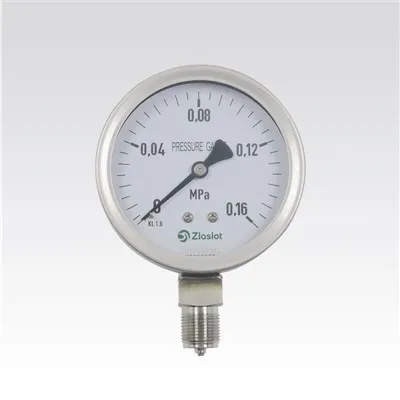

What are the factors to consider when buying a pressure gauge?
Leave a message

When it comes to buying a pressure gauge, there are quite a few factors you need to take into account. As a pressure gauges supplier, I've seen firsthand how important it is to make the right choice. In this blog post, I'll share some key considerations that can help you pick the perfect pressure gauge for your needs.
1. Pressure Range
The first thing you gotta think about is the pressure range. You need to know the minimum and maximum pressure levels that your gauge will be dealing with. If the pressure goes beyond the gauge's range, it can lead to inaccurate readings or even damage the gauge.
For example, if you're working in a low - pressure environment, like a home plumbing system, a gauge with a range of 0 - 100 psi might be sufficient. But if you're in an industrial setting where high pressures are the norm, you'll need a gauge with a much higher range. Our Mechanical Presssure Gauge comes in a variety of pressure ranges, so you can find one that fits your specific requirements.
2. Accuracy
Accuracy is crucial when it comes to pressure gauges. Even a small error in reading can have big consequences, especially in industries where precision is key. The accuracy of a pressure gauge is usually expressed as a percentage of the full - scale reading.
For general applications, an accuracy of ±1% might be okay. But in more critical applications, like in the aerospace or medical industries, you might need a gauge with an accuracy of ±0.25% or even better. When you're shopping for a pressure gauge, make sure to check the accuracy specifications. Our gauges are carefully calibrated to ensure high - level accuracy, so you can trust the readings you get.


3. Environment
The environment in which the pressure gauge will be used is another important factor. If the gauge is going to be exposed to extreme temperatures, humidity, vibration, or corrosive substances, you need to choose a gauge that can withstand these conditions.
For high - temperature environments, our High Temperature Mechanical Melt Presssure Gauges are a great option. They're designed to handle high temperatures without losing their accuracy or functionality. On the other hand, if the gauge will be in a wet or humid environment, you'll want a gauge with a waterproof or moisture - resistant housing.
4. Type of Pressure
There are different types of pressure that you might need to measure, such as absolute pressure, gauge pressure, and differential pressure.
- Absolute Pressure: This is the total pressure, including atmospheric pressure. It's often used in applications like vacuum systems. Our Vacuum Digital Pressure Gauge is perfect for measuring absolute pressure in vacuum environments.
- Gauge Pressure: This is the pressure relative to atmospheric pressure. Most industrial applications use gauge pressure measurements.
- Differential Pressure: This is the difference in pressure between two points. It's commonly used in flow measurement and filter monitoring applications.
Make sure you know which type of pressure you need to measure and choose a gauge accordingly.
5. Display
The display of the pressure gauge is also an important consideration. There are two main types of displays: analog and digital.
- Analog Displays: These are the traditional type of displays with a needle and a dial. They're easy to read at a glance and are often more rugged and reliable. They're a good choice for applications where a quick visual check is needed.
- Digital Displays: These displays show the pressure as a numerical value. They're more accurate and can provide additional features like data logging and alarms. They're great for applications where precise readings and data collection are required.
Think about how you'll be using the gauge and which type of display will work best for you.
6. Connection Type
The connection type of the pressure gauge is important for proper installation. You need to make sure that the gauge can be easily connected to your system. There are different types of connections, such as threaded connections, flange connections, and quick - connect fittings.
Check the specifications of your system and choose a pressure gauge with a compatible connection type. Our gauges come with a variety of connection options, so you can find one that fits your setup.
7. Cost
Cost is always a factor when making a purchase. You need to balance your budget with the features and quality you need. Cheaper gauges might seem like a good deal at first, but they might not offer the accuracy, durability, or functionality you require in the long run.
On the other hand, high - end gauges with all the bells and whistles can be very expensive. Consider your specific needs and find a gauge that offers the best value for your money. We offer a range of pressure gauges at different price points, so you can find one that fits your budget without compromising on quality.
8. Brand and Reputation
The brand and reputation of the pressure gauge supplier matter. A well - established brand with a good reputation is more likely to offer high - quality products and reliable customer service.
When you're buying a pressure gauge, do some research on the brand. Look for customer reviews and testimonials to see what other users have to say about the products. As a pressure gauges supplier, we've built a solid reputation for providing top - notch products and excellent customer support. You can trust us to deliver the right pressure gauge for your needs.
Conclusion
Buying a pressure gauge isn't as simple as it might seem. There are many factors to consider, from the pressure range and accuracy to the environment and display type. By taking the time to think about these factors, you can make an informed decision and choose a pressure gauge that will work well for your specific application.
If you're in the market for a pressure gauge, we'd love to help you find the perfect one. Whether you need a Mechanical Presssure Gauge, a Vacuum Digital Pressure Gauge, or a High Temperature Mechanical Melt Presssure Gauges, we've got you covered. Contact us to start the procurement process and let's discuss your requirements in detail.
References
- Pressure Gauge Handbook: A Guide to Selection, Installation, and Maintenance.
- Industrial Pressure Measurement: Principles and Applications.