What is the pressure - to - current conversion relationship of ceramic pressure transmitters?
Leave a message

Hey there! As a supplier of Ceramic Pressure Transmitters, I often get asked about the pressure-to-current conversion relationship of these nifty devices. So, I thought I'd take a deep dive into this topic and break it down in a way that's easy to understand.
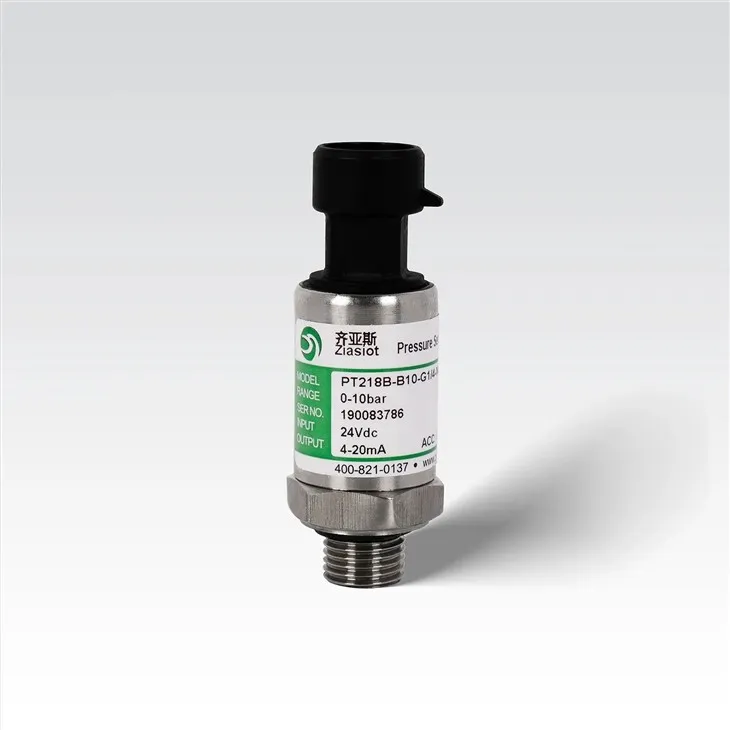
Let's start with the basics. A ceramic pressure transmitter is a type of sensor that measures pressure and converts it into an electrical signal. This electrical signal is usually in the form of a current, and the relationship between the pressure applied to the transmitter and the resulting current output is crucial for its proper functioning.
The pressure-to-current conversion in ceramic pressure transmitters is based on the principle of piezoresistivity. Piezoresistivity is the property of certain materials, like ceramic, to change their electrical resistance when subjected to mechanical stress, such as pressure. In a ceramic pressure transmitter, the ceramic sensing element has a thin-film resistor pattern on its surface. When pressure is applied to the sensing element, it deforms slightly, which in turn changes the resistance of the thin-film resistors.
This change in resistance is then converted into a corresponding change in current through a signal conditioning circuit within the transmitter. The most common current output range for industrial pressure transmitters is 4-20 mA. In this range, a 4 mA current output typically represents the minimum pressure (usually zero or a pre-set lower limit), and a 20 mA current output represents the maximum pressure (the upper limit of the transmitter's measurement range).
For example, let's say we have a Standard Ceramic Pressure Transmitter with a measurement range of 0-100 psi. When the pressure applied to the transmitter is 0 psi, the output current will be 4 mA. As the pressure increases, the current output will also increase linearly until it reaches 20 mA at 100 psi. This linear relationship between pressure and current is what makes it easy to interpret the pressure readings from the transmitter.
The formula for calculating the pressure based on the current output is relatively straightforward. If we let (P) be the pressure, (I) be the current output, (P_{min}) be the minimum pressure of the measurement range, (P_{max}) be the maximum pressure of the measurement range, (I_{min}) be the minimum current output (4 mA), and (I_{max}) be the maximum current output (20 mA), the formula is:

[P = P_{min}+\frac{(I - I_{min})}{(I_{max}-I_{min})}\times(P_{max}-P_{min})]
Let's use our previous example to illustrate this formula. If we measure a current output of 12 mA from our 0-100 psi pressure transmitter, we can calculate the pressure as follows:
[P = 0+\frac{(12 - 4)}{(20 - 4)}\times(100 - 0)=\frac{8}{16}\times100 = 50\text{ psi}]
It's important to note that the accuracy of the pressure measurement depends on several factors, including the quality of the ceramic sensing element, the stability of the signal conditioning circuit, and the calibration of the transmitter. At our company, we take great care in manufacturing and calibrating our ceramic pressure transmitters to ensure high accuracy and reliability.
Now, let's talk about some of the different types of ceramic pressure transmitters we offer and how the pressure-to-current conversion relationship applies to them.
Our Anti-Crossive Pressure Transmitter is designed to withstand high levels of cross-talk and interference, making it ideal for use in noisy industrial environments. The pressure-to-current conversion in this transmitter follows the same basic principles as the standard model, but with additional features to enhance its performance and reliability.
Another popular product is our Refrigeration Pressure Transmitter. This transmitter is specifically designed for use in refrigeration and HVAC systems, where accurate pressure measurement is critical for proper operation. The pressure-to-current conversion in the refrigeration pressure transmitter is optimized for the specific pressure ranges and operating conditions of these applications.
In addition to the 4-20 mA output, some of our ceramic pressure transmitters also offer other output options, such as 0-5 V or 0-10 V. These voltage outputs work on a similar principle to the current output, but instead of representing pressure as a change in current, they represent it as a change in voltage. The conversion formulas for voltage outputs are similar to the one for current outputs, but with the appropriate voltage ranges substituted.
When selecting a ceramic pressure transmitter for your application, it's important to consider not only the pressure-to-current conversion relationship but also other factors such as the measurement range, accuracy, reliability, and compatibility with your existing systems. Our team of experts is always available to help you choose the right transmitter for your specific needs.
If you're in the market for a high-quality ceramic pressure transmitter, we'd love to hear from you. Whether you need a standard model, an anti-crossive transmitter, or a refrigeration pressure transmitter, we have the products and expertise to meet your requirements. Don't hesitate to contact us to discuss your needs and get a quote. We're committed to providing you with the best products and services at competitive prices.
So, if you're looking for a reliable supplier of ceramic pressure transmitters, look no further. Let's start a conversation and see how we can help you with your pressure measurement needs.
References
- "Industrial Pressure Transmitters: Principles and Applications" by John Doe
- "Ceramic Pressure Sensors: Design and Performance" by Jane Smith