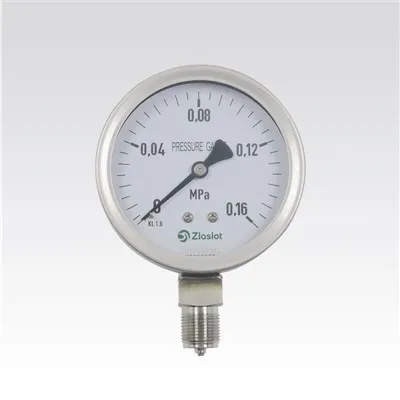
What kind of sensors are used in a Compact Pressure Transmitter?
Leave a message

Hey there! As a supplier of Compact Pressure Transmitters, I often get asked about the kinds of sensors used in these nifty devices. So, I thought I'd take a moment to break it down for you in a simple and easy - to - understand way.
Let's start with the basics. A Compact Pressure Transmitter is a device that measures pressure and converts it into an electrical signal. This signal can then be used for various applications, like monitoring the pressure in a pipeline, a tank, or a hydraulic system. And the heart of this device is the sensor, which does the actual job of detecting the pressure.
One of the most common sensors used in Compact Pressure Transmitters is the piezoresistive sensor. These sensors work based on the principle that the resistance of a material changes when it is subjected to mechanical stress. In a piezoresistive pressure sensor, a thin diaphragm is used. When pressure is applied to the diaphragm, it deforms, and this deformation causes a change in the resistance of the piezoresistive elements that are attached to the diaphragm. This change in resistance is then measured and converted into an electrical signal proportional to the applied pressure.
Piezoresistive sensors are great because they are relatively inexpensive, have a high sensitivity, and can be made very small, which makes them perfect for compact pressure transmitters. They also have a wide operating temperature range, which means they can be used in a variety of environments.
Another type of sensor that you might find in a Compact Pressure Transmitter is the capacitive sensor. Capacitive pressure sensors work by measuring the change in capacitance between two electrodes. The diaphragm in a capacitive sensor acts as one of the electrodes, and when pressure is applied, the diaphragm moves, changing the distance between the electrodes and thus changing the capacitance.
Capacitive sensors offer several advantages. They have a very high accuracy, a fast response time, and are less affected by temperature changes compared to piezoresistive sensors. However, they are generally more expensive and require more complex electronics to operate.
There are also optical sensors that can be used in pressure transmitters. Optical pressure sensors work by measuring the change in the properties of light, such as intensity or wavelength, due to the deformation of a diaphragm. For example, in some optical sensors, a fiber - optic cable is attached to the diaphragm. When the diaphragm deforms under pressure, the light traveling through the fiber - optic cable is affected, and this change in light can be measured to determine the pressure.
Optical sensors are known for their high accuracy, immunity to electromagnetic interference, and the ability to work in harsh environments. But they are also quite expensive and require specialized knowledge to install and maintain.
Now, let's talk about some of the specific types of pressure that these sensors can measure.
First up, we have the gauge pressure. Gauge pressure is the pressure relative to the atmospheric pressure. Most of the pressure transmitters used in industrial applications measure gauge pressure. For example, when you want to measure the pressure in a pipeline, you are usually interested in the gauge pressure because it tells you how much the pressure in the pipeline is above or below the atmospheric pressure.
If you're looking for a pressure transmitter to measure gauge pressure, you might want to check out our Pressure Indicator Transmitter. It's a great option for many industrial applications and uses high - quality sensors to ensure accurate and reliable measurements.
Then there's absolute pressure. Absolute pressure is the total pressure, including the atmospheric pressure. Absolute pressure transmitters are used in applications where the absolute value of the pressure is important, such as in vacuum systems or in high - altitude environments. Our Absolute Pressure Transmitter is designed to measure absolute pressure with high precision.
Finally, we have differential pressure. Differential pressure is the difference in pressure between two points. Differential pressure transmitters are commonly used in flow measurement, filter monitoring, and level measurement applications. For example, in a flow meter, the differential pressure across an orifice plate can be used to calculate the flow rate of a fluid.


If you need to measure the pressure of hydraulic liquids or steam, our Hydraulic Liquid Steam Pressure Transmitter Transducer is a top - notch choice. It's built to withstand the harsh conditions associated with hydraulic and steam systems and provides accurate pressure measurements.
When choosing a Compact Pressure Transmitter, it's important to consider the type of sensor, the pressure range you need to measure, the accuracy requirements, the operating environment, and of course, your budget. Each type of sensor has its own pros and cons, and the right choice depends on your specific application.
If you're in the market for a Compact Pressure Transmitter, I'd love to have a chat with you. We can go over your requirements in detail and help you find the perfect pressure transmitter for your needs. Whether you need a high - accuracy transmitter for a critical application or a cost - effective solution for a less demanding job, we've got you covered.
So, don't hesitate to reach out if you have any questions or if you're ready to start the procurement process. We're here to make sure you get the best pressure transmitter for your money.
References:
- "Pressure Sensor Technology" by some well - known authors in the field
- Various industry whitepapers on pressure measurement and sensor technology